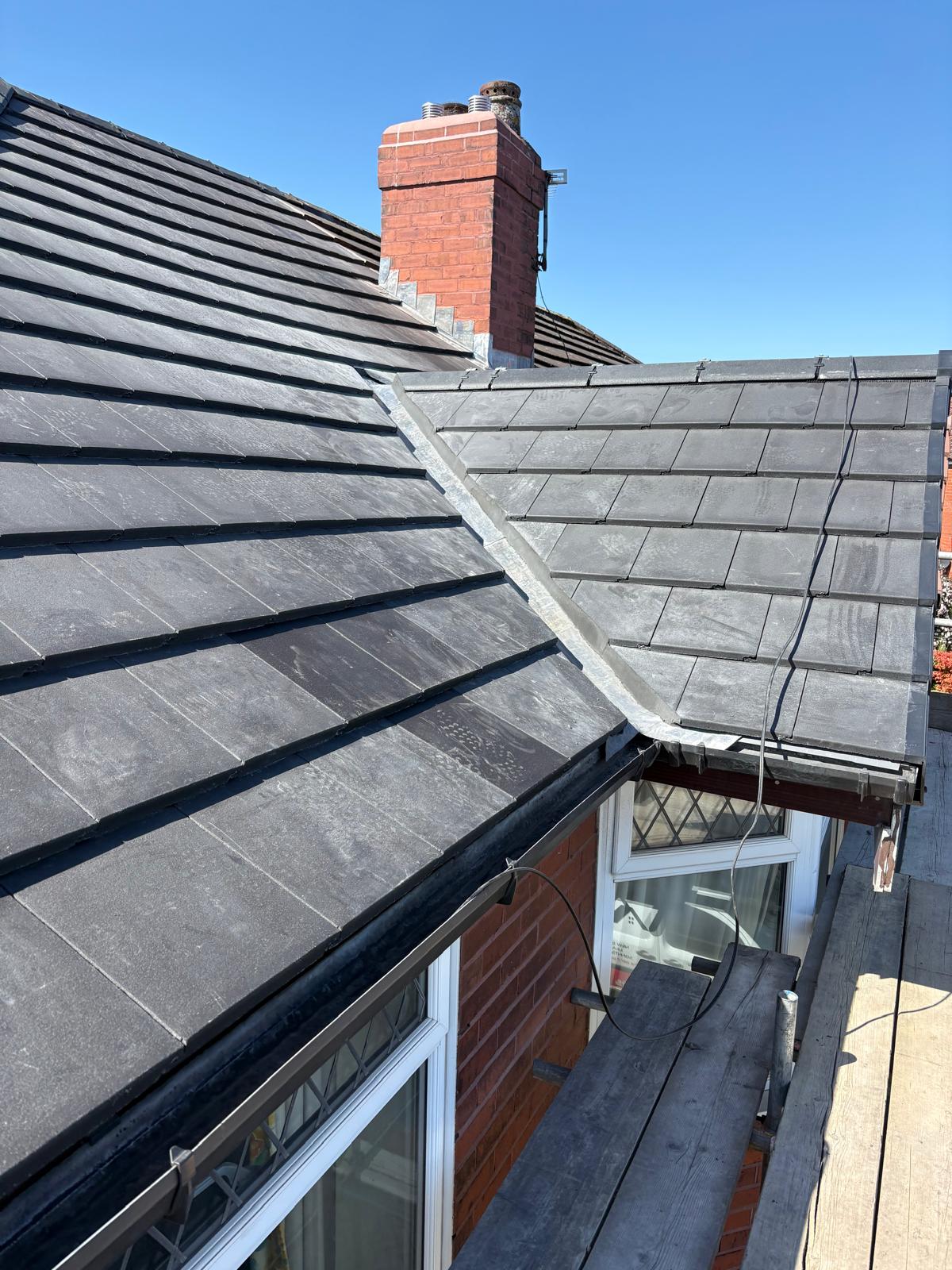
How Often Should Gutters Actually Be Cleared?
There is no single correct interval, and any answer that does not ask about your trees, your roof and your gutter size is guessing. What decides it is how much material arrives, how fast the system carries water away, and how much damage an overflow would do. For most houses the honest answer is once or twice a year.
Key takeaways
- Trees are the biggest single variable, and their distance and type matter more than their number.
- An ageing concrete tile roof sheds grit that blocks gutters as effectively as leaves do.
- Where the overflow lands decides how urgent the interval is: over a wall matters more than over a lawn.
- Twice a year suits most properties in this region, with autumn being the essential one.
- Guards reduce the problem and do not remove it, whatever they are sold as.
Why a single answer does not exist
Two identical houses on the same street can need completely different intervals. One has a mature sycamore twenty feet from the gable and the other has an open aspect. One has a concrete tile roof forty years old that is shedding its surface, the other was recovered last year. One has a single downpipe on a long run, the other has two. One overflows onto a lawn, the other onto a wall above a doorway. Every one of those differences changes the right answer, which is why generic advice about gutters is close to useless and why it is worth working out your own interval rather than adopting somebody else's.
Trees, and which ones actually cause trouble
Proximity matters more than size: a modest tree overhanging the roof delivers far more material than a large one at the end of the garden. Species matters too. Broadleaf trees that drop in a concentrated period produce a heavy autumn load that arrives all at once. Evergreens shed smaller amounts continuously through the year, which produces a steady accumulation that never has an obvious moment for clearing. Trees that drop seeds, blossom or needles as well as leaves extend the problem across more of the year. If anything overhangs the roof at all, plan on at least twice a year and check after heavy leaf fall.
The material that is not leaves
People associate gutter blockage with leaves and then find their gutters blocked on a treeless plot. The other main contributor is the roof itself. Concrete tiles lose their surface finish over decades and shed a fine grit that washes into the gutter and settles as a dense sludge, which packs tighter than leaves and is harder to flush. Moss growing on the covering breaks down and does the same. Older mortar bedding sheds material as it erodes. Birds nesting in the eaves push debris down. On an ageing roof with no trees nearby, the gutters can still need clearing annually, and the material found in them tells you about the state of the roof above.
Where the overflow goes, which sets the urgency
The consequence of a blockage is not uniform. Water spilling over the front of a gutter onto a lawn is a nuisance. Water spilling over the back, between the gutter and the fascia, runs down the timber and into the eaves, which rots boards and wets the top of the wall. Water discharging onto a wall keeps that masonry permanently damp with the frost damage that follows. Water landing on a path becomes ice in winter. So the same blockage matters more on some elevations than others, and the runs above walls, doorways and paths deserve a shorter interval than the ones over a border.
How to tell whether yours needs doing
The most reliable test is watching during rain rather than inspecting in dry weather. Position yourself well back while it is raining properly and follow each length with your eye. Water reaching the outlet and going down cleanly, with nothing over the front and nothing behind, means the system is working whatever it looks like from a ladder. Overflow at one point suggests a local blockage or a fall problem. In dry weather, look for plants growing out of the gutter, which is conclusive, for staining or a green streak on the wall below, which shows habitual escape, and for a sagging section, which is usually holding standing water.
A reasonable default
For most properties in a wet region with some planting nearby, twice a year is proportionate: once in late autumn after the bulk of leaf fall, which is the essential one, and once in spring to clear whatever winter deposited and to check the system before it is needed less. Properties with no overhanging trees and a modern roof may manage on annual clearing. Properties under mature trees, with evergreens, or with an ageing covering shedding grit may need three visits. Somewhere with a single downpipe serving a long run needs it more often than the same roof with two, because there is less tolerance for restriction.
Not sure what you need? Call and we'll tell you straight.
150+ Google reviews. Dave has 25 years on the tools.
Guards, honestly assessed
Mesh guards, brush inserts and covers are marketed as ending the job entirely, and they do not. Their genuine benefit is on a property under broadleaf trees, where they keep the bulk of the leaf load out of the channel. Their limitations are twofold: material accumulates on the upper surface instead, in a position that is more awkward to deal with than the inside of a gutter, and the finer debris that causes the densest blockages passes through regardless. Treated as something that stretches the interval, they can be a sound purchase. Treated as a permanent answer, they lead to gutters nobody has looked at for five years.
Doing it properly rather than quickly
Clearing means removing material, not redistributing it. Debris pushed along a gutter arrives at the outlet and blocks the downpipe, which converts a visible problem into an invisible one. A proper clear takes the material out, checks that each outlet and downpipe runs, and confirms the water reaches a gully at the bottom rather than the ground. It should also include a look at the brackets, the joints and the fall while somebody is there, since that costs nothing extra and catches the problems that clearing alone will not fix. Ask what was found as well as what was removed.
The economics, which are not close
Gutter clearing is among the cheapest work that will ever be done on a building, and the damage it prevents is among the more expensive. Rotted fascia and soffit, saturated wall heads, damp inside upstairs rooms, frost damaged brickwork and wet eaves insulation all begin with water going where it should not for long enough. Every one of those repairs costs multiples of a lifetime of gutter clearing. That asymmetry is the whole argument, and it is why the interval question is worth answering deliberately rather than defaulting to whenever somebody happens to knock at the door.
Working out your own interval
Rather than adopting a general figure, the practical approach is to establish yours empirically over two years. Clear them, note the date, then look at what has accumulated after six months and again after twelve. If they are close to blocking at six months, that is the interval. If they are barely dirty at twelve, annual is enough. The evidence is specific to your trees, your roof and your gutter sizing, which is exactly what generic advice cannot account for, and it takes no expertise to gather. After two cycles you will have a schedule that suits the building rather than one that suits an article.
What the debris tells you about the roof
Beyond deciding when to clear again, what comes out of a gutter is genuinely diagnostic. Predominantly leaves means the trees are the driver and the interval is about the seasons. A dense sandy sludge means the roof covering is shedding its surface, which says something about the age and condition of the tiles above. Moss in quantity means the covering is holding moisture and probably has been for years. Fragments of mortar mean the ridge, verge or chimney is breaking up. Pieces of tile mean something has failed. It is worth asking whoever clears them what they found, because that answer amounts to a free assessment of the roof above, given by somebody who has just spent time looking at it closely from the one position that actually shows the eaves and the lower courses properly.
Frequently Asked Questions
Related services
More from the blog
About the author
David Boardman founded Boardman Roofing in 2018. Dave has 25 years on the tools. Read 150+ Google reviews or call 07879 736629.
Get a free quote today
150+ Google reviews. Dave has 25 years on the tools.
Have a roof problem you want a real roofer to look at? Free written quote, no pressure.