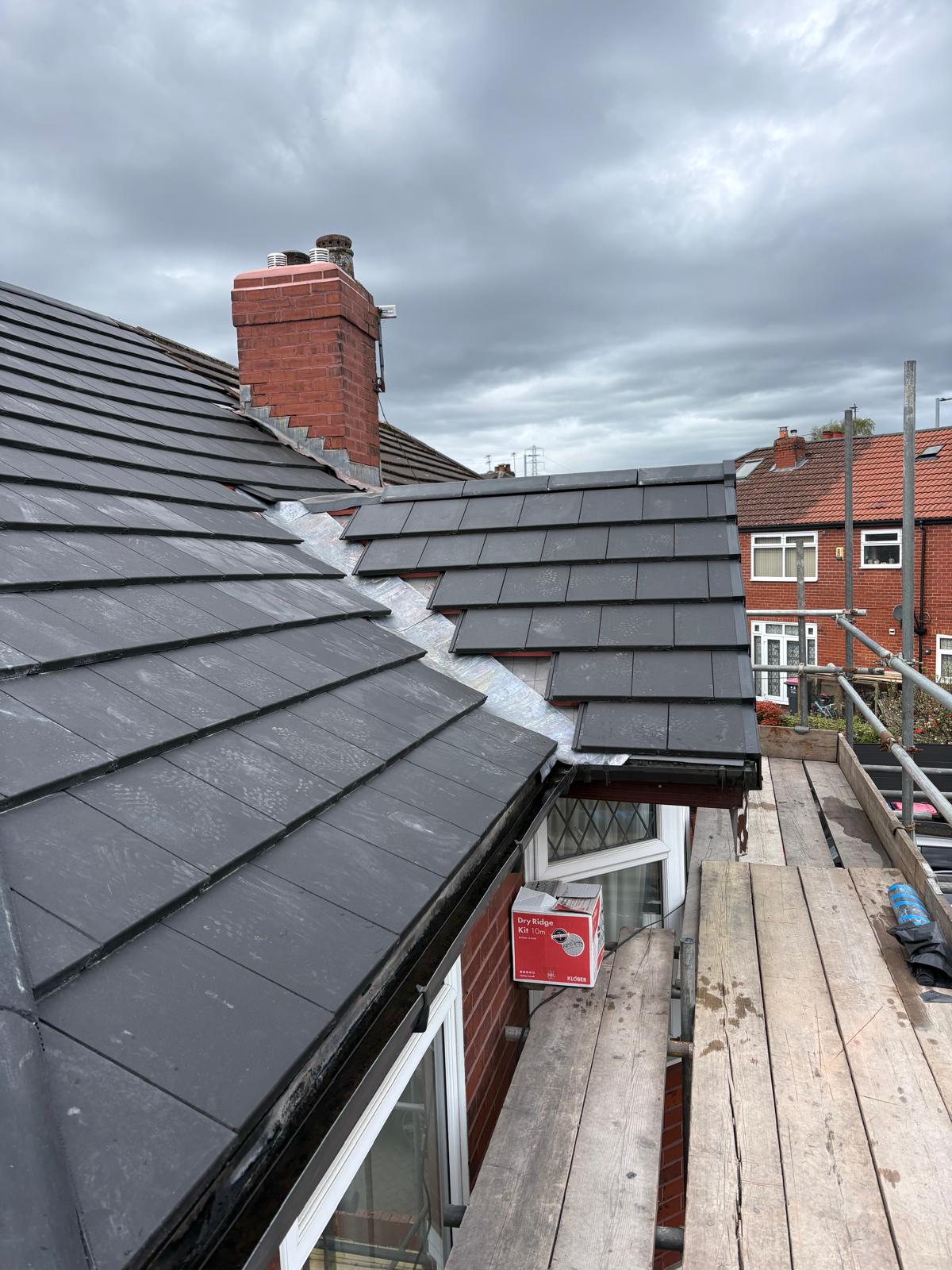
New Roofs and Reroofs in Manchester
Most people who ring us about a new roof are not certain they need one. Somebody has been up and said it has had its day, or a neighbour has just had theirs done, and now there is a figure in your head and no way of checking it. Sometimes a strip and recover is the answer. Just as often it is a day on the ridge and a dozen slates, and we would rather tell you that. Boardman Roofing strips and recovers roofs across Manchester in slate and tile. Dave looks at yours properly first, then puts a free written quote in your hands with the work set out line by line.
Free written quote with no obligation.
Repair or replace, honestly
Age on its own decides nothing. What decides it is whether the covering still sheds water and whether the fixings holding it on have anything left. One slate off after a gale is a repair. Six down the same slope over two winters, in a different place each time, is the fixings going, and they do not recover. The test we use is whether the same roof keeps costing you money in new places. One repair in a decade is a roof doing its job. Three in two years, each somewhere else, is a covering that is finished. Where it is genuinely borderline, Dave prices the repair and the reroof in one free written quote so you can hold the two side by side.
How a roof reaches the end of its life
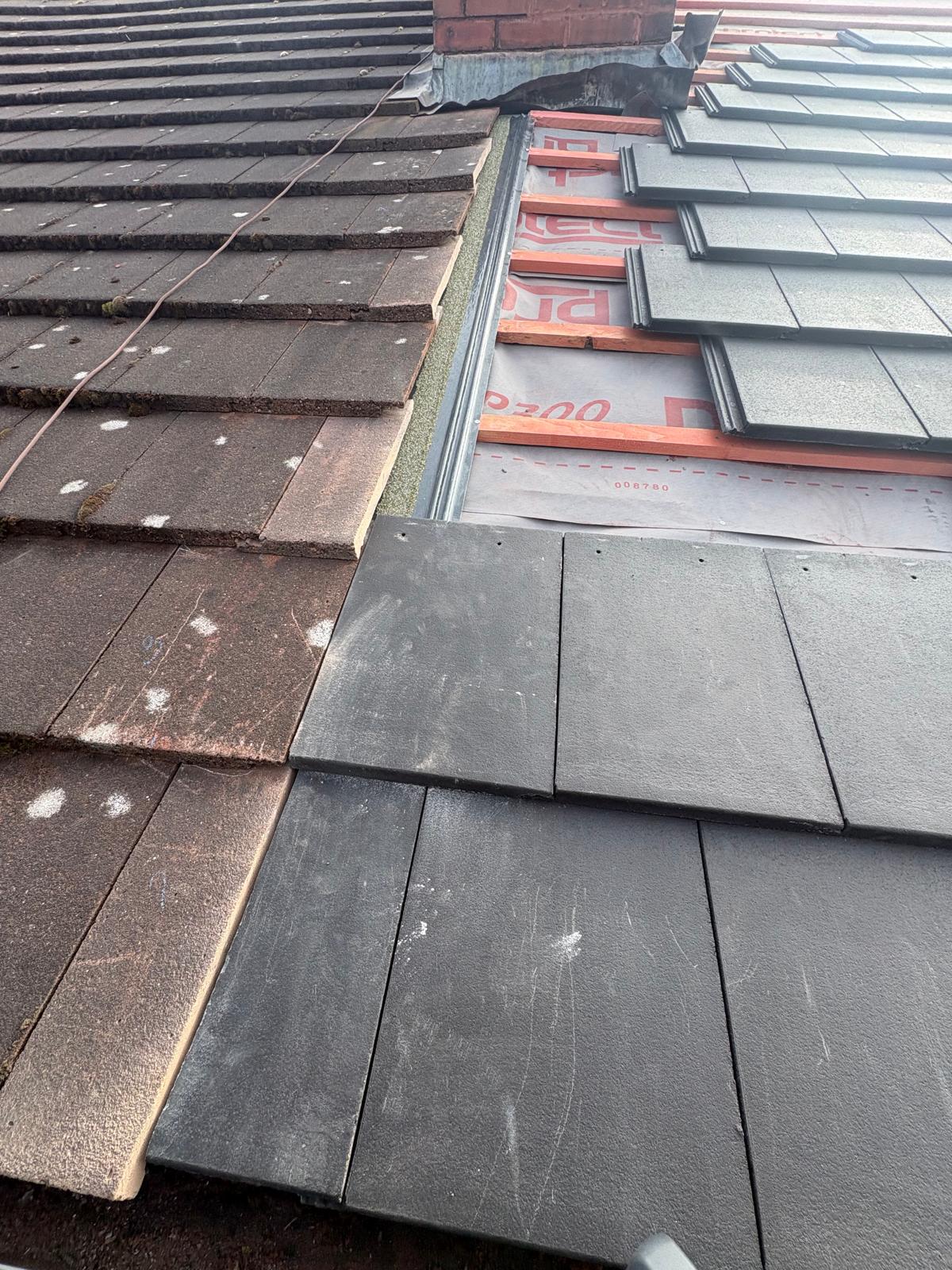
It starts with the fixings, not the covering. On a Victorian slate roof the nails corrode long before the slate does, which is why we pick a hundred year old Welsh slate off a lawn and find it perfectly sound. That is nail sickness, and it carries on across the slope. On the interlocking concrete tiles that went onto most semis from the seventies, the tile itself goes: the surface weathers off and frost opens the laps. Under both, the old bitumen underlay perishes and tears where it sags between rafters. Battens follow, because timber that stays wet stops gripping a nail.
How to read your own roof from the ground
Stand at the far corner of the garden and look along the slope rather than at it. A sound roof reads as one flat plane, so a hollow between rafters, a dip in the ridge or a wave along the eaves is movement, and movement is structural. Then count what is missing. Ones and twos scattered over a whole slope, in a different spot each year, is a different problem from three gone together under one overflowing gutter. Inside, pick a bright day, go up into the loft and turn the light off. Daylight at the eaves is usually ventilation. Daylight halfway up a slope is a tear in the underlay.
What it costs you to leave it
A tired covering is a cheap problem for a long time and then it is not. Water past the underlay wets the battens, the battens let go of the nails, and more of the covering slips each winter. From there it reaches the rafter feet on the wall plate, the dampest part of the roof and the one place nobody looks. By then the money has moved from covering and battens, which we can price accurately, to timber, which we cannot until it is open.
What Manchester roofs are actually covered with
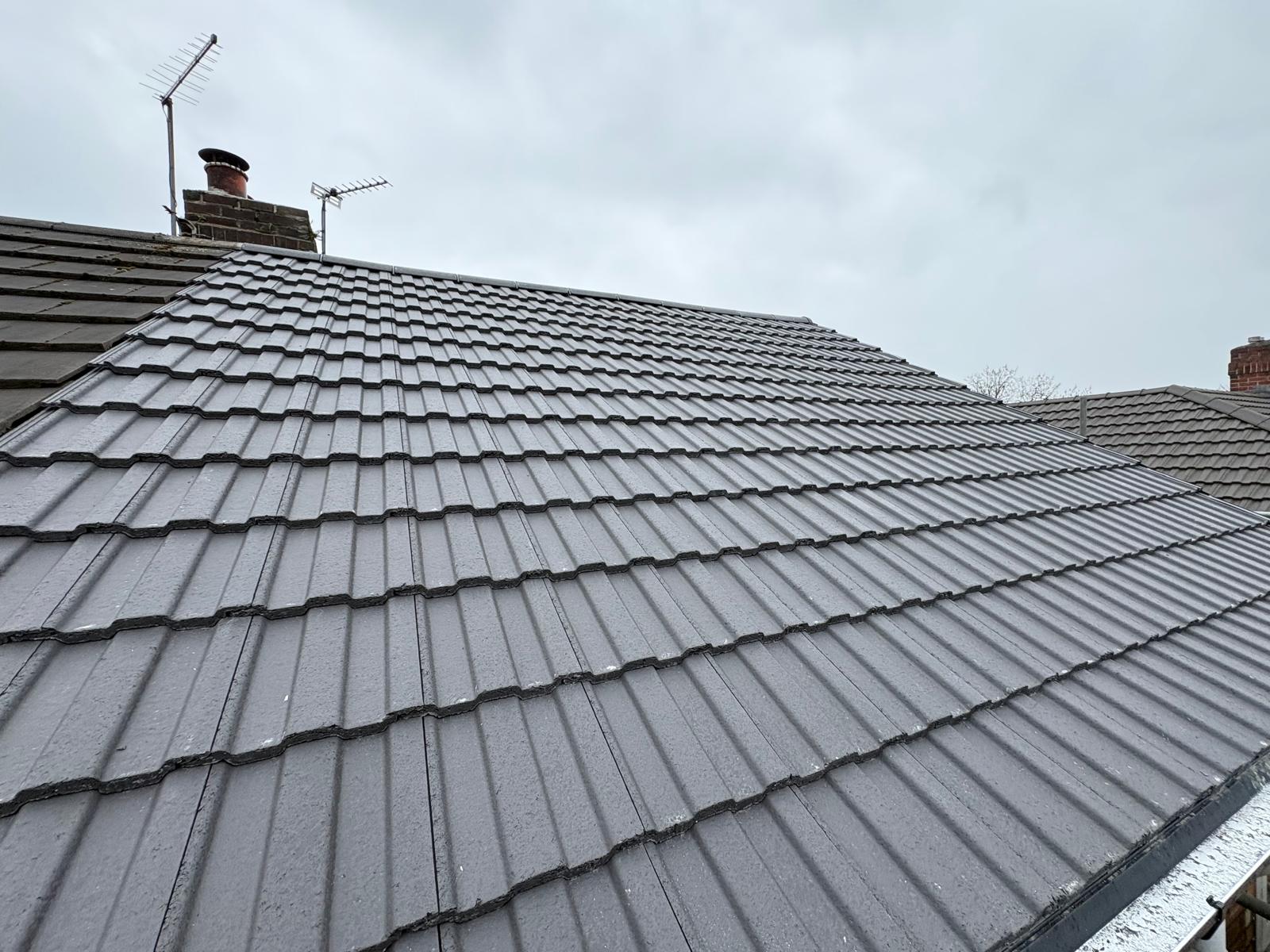
The Victorian terraces off Chorley Road in Swinton, through Pendlebury and into Ordsall, are Welsh slate with lead valleys between paired roofs, and the valley usually gives trouble before the slate does. The interwar semis around Wardley, along Walkden Road and up through Prestwich went up under clay plain tile, and a great many were recovered in Marley or Redland interlocking concrete from the seventies onwards, which is a different roof with a different life in it. On a terrace or a pair of semis we raise matching early, because recover one and leave the other and you see the join from the pavement for ever.
Not sure what you need? Call and we'll tell you straight.
150+ Google reviews. Dave has 25 years on the tools.
How we do a strip and recover
Scaffold up and netted, then the covering comes off into the skip rather than down the slope. On a narrow street we sort the pavement licence first. With the roof open we go over the timber: rafter feet, the wall plate, anything that has been wet. We never reuse rotten battens. Then breathable membrane, treated battens, and the covering fixed to suit the pitch and the exposure. Since the 2014 revision of BS 5534 that means ridge and hip are mechanically fixed rather than trusted to mortar alone, so a ridge is either dry fixed or bedded and fixed, and Dave says which yours is getting. New lead to chimneys and valleys rather than lifting the old back down. All of it is set out beforehand in a free written quote.
Solar panels and a reroof
If there are panels on the slope they have to come off before anything is stripped and go back afterwards, and that gets planned rather than discovered on day one. We do not install solar and we do not touch the electrical side of it, so isolating the array and reconnecting it is your installer's work or an electrician's, booked for the right days. The mounting feet are a roofing detail. They pass through the covering, and a leak around an array is far more often the flashing kit at the feet than the panels themselves.
Building control, and what we do not certify
Recovering a slope is not always just roofing in the eyes of the regulations. Renewing more than a quarter counts as work to a thermal element under Part L, and where it does an insulation upgrade is normally expected. Swapping a light covering for a much heavier one is a structural question as well. Either way it is a short phone call to building control, much better made before the scaffold goes up. We will tell you what we think applies, and we do not self certify this work.
What moves the price on a reroof
Area is only the starting point. Pitch and height come next, then the hips, valleys, dormers and chimneys, because every one of those is a hand formed detail rather than a run of tiling and they are where the hours go. Scaffold is costed on which elevations have to be covered and what sits under them, so a pavement, a shared drive or a neighbour's conservatory all change it. Then the covering, since natural slate costs a good deal more than concrete tile before one is laid. Whether a mid terrace can be reached at all without going through the house is the one that most often moves a figure late. We do not price a reroof off a photograph.
Areas we cover for new roofs and reroofs
Related services
Guides on this work
Frequently Asked Questions
Get a free quote today
150+ Google reviews. Dave has 25 years on the tools.
Free written quote with no obligation.