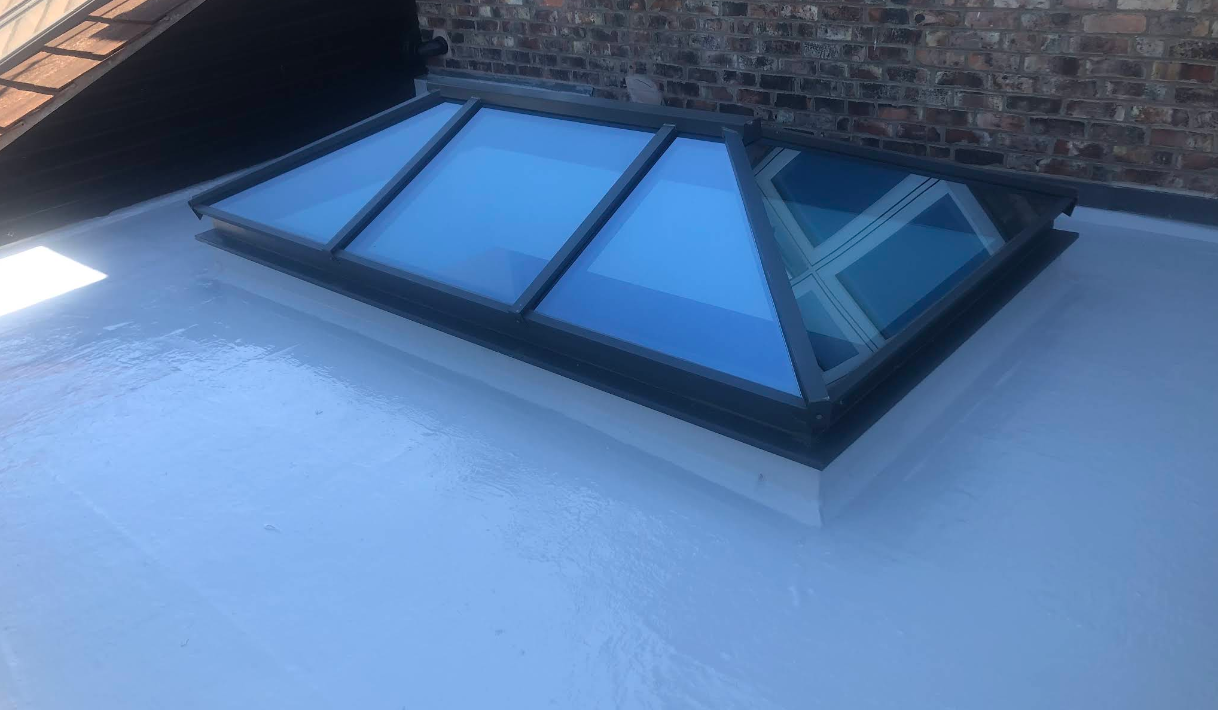
Flat Roofing in Manchester
It usually shows up as a stain on the extension ceiling after a wet week, or as water still lying up there two days after the rain stopped. Neither means the whole roof is finished and neither means it is fine. We repair and recover flat roofs across Manchester on extensions, back additions and main roofs, in felt, EPDM rubber, fibreglass and liquid systems. Dave gets on it and finds what has actually failed rather than what is easiest to point at, then gives you a free written quote for putting it right.
Free written quote with no obligation.
How a flat roof really fails
Almost never in the middle. The flat part is the easy part. What goes wrong happens where the covering stops or turns a corner. On most of the roofs we open up it is the upstand where the roof meets the house wall, where somebody ran mastic instead of a dressed flashing. Then the drip trim, then the outlet. Once water is into the deck, the deck moves: chipboard swells at the joints, plank decking cups, and the covering splits along that movement. Blisters are the other half of it, trapped moisture turning to vapour in the sun and lifting the layers apart.
How to read it yourself
Look down on it from an upstairs window an hour after heavy rain. A puddle gone within a day is normal on an older roof. One still there two days later with a dirty tide ring round it is ponding, and it finds a pinhole eventually. Check the outlet is clear, because a blocked one turns the roof into a shallow tank. Then look at the junction with the house wall. Our flashings are chased into a mortar joint and dressed over the upstand, and a smear of mastic on brick is not that. Inside, water runs along the joists before it drops, so the stain is often nowhere near the hole.
What happens if it is left
The covering is cheap and the deck is not. Once boarding has been wet through two winters it stops holding a fixing, and nothing we lay over it will last. That is the decision this whole page turns on, because it is the difference between us recovering a roof and rebuilding one. Left longer it reaches the joists and the wall plate, and on a warm deck it soaks the insulation, which then holds water against the timber. Inside you get the ceiling, then the plaster under the abutment.
Warm deck and cold deck, and why it matters
There are two ways to build a flat roof and they behave very differently. The older is a cold deck: insulation between the joists, an air gap above it, covering on top. It only works if that gap is ventilated at both ends, and on most extensions it is not, so warm damp air from the room below condenses under the deck and rots it from the inside while the covering still looks perfect. Plenty of the roofs we strip failed that way rather than from rain. The modern one is a warm deck: vapour control layer, rigid insulation over the whole deck, covering above that, and nothing cold left for moisture to condense on. That is what we build when we renew a covering.
Not sure what you need? Call and we'll tell you straight.
150+ Google reviews. Dave has 25 years on the tools.
Falls, ponding and where the water leaves
A flat roof is not flat. It is a shallow slope with one job, which is to shift water off before it finds a way in. BS 6229 asks for a design fall of one in forty so that once the timbers have deflected there is still a real fall of one in eighty. A lot of the extension roofs put up round here in the sixties and seventies were laid dead level, so they have never drained, and a recover ignoring that buys two years. Where the fall is wrong we build it back with firrings over the joists. Then the outlet, because one outlet on a wide roof is a single point of failure.
The systems, and which one goes where
Reinforced felt is the workhorse. Torched in layers under a mineral cap sheet, it copes with movement and is easy to repair later. EPDM rubber is a single sheet bonded down, and on most domestic roofs the field has no joints at all, which suits odd shapes and plenty of upstands. Fibreglass, or GRP, is laid wet onto a new ply deck and cures into one hard surface with the trims built in. It gives the tidiest finish and it is the least forgiving of a deck that moves. Liquid systems are cold applied and reinforced as they go, and they earn their money on complicated detail, round pipes and rooflights. Which one belongs on your roof depends on the deck and the shape, and Dave names the one he would use and says why in the written quote.
The flat roofs Manchester actually has
Around Salford, Eccles and Monton nearly every terrace has a back addition with a flat roof over the kitchen, tucked behind a parapet where nobody sees it and where the water leaves through one hidden outlet. The interwar semis gained a rear extension, and the ones added between the sixties and the eighties are on their second or third covering. Larger houses in Withington and Ellesmere Park hide a flat section behind a parapet, where the box gutter matters more than the roof.
Repair, recover or strip, and what moves the figure
A localised repair is right when the deck is dry and the fault is a detail: a split upstand, a lifted trim, a blocked outlet. A recover suits a sound deck under a covering at the end of its life. A strip is the answer once the boarding has gone soft, and Dave lifts a corner to find out rather than guess. What we will not do is paint a coating over a roof that is holding water and call it a repair. What moves the figure is how much boarding comes out, whether the fall has to be rebuilt in firrings, how many upstands, trims and outlets there are, and whether insulation is going in, which raises the finished level and has to be checked against door thresholds and the damp course. Whichever of the three it is, you get it priced in writing first and no pressure from us to go ahead.
Areas we cover for flat roofing
Related services
Guides on this work
Frequently Asked Questions
Get a free quote today
150+ Google reviews. Dave has 25 years on the tools.
Free written quote with no obligation.