Chimney Repairs and Leadwork in Manchester
A damp patch on the chimney breast in the back bedroom, a brown ring on the ceiling beside the stack, or mortar dropping into the gutter. A chimney is the most exposed thing on the house and it is what we get called to most for a leak. A chimney leak is a lead job as much as a brickwork one, which is why the stack and the lead round it come off one scaffold, in one visit, on one quote. We repoint, rebuild above the roof line, renew flaunching and pots and cut new lead in properly. Dave looks at the stack first and you get a free written quote.
Free written quote with no obligation.
How a stack fails, in order
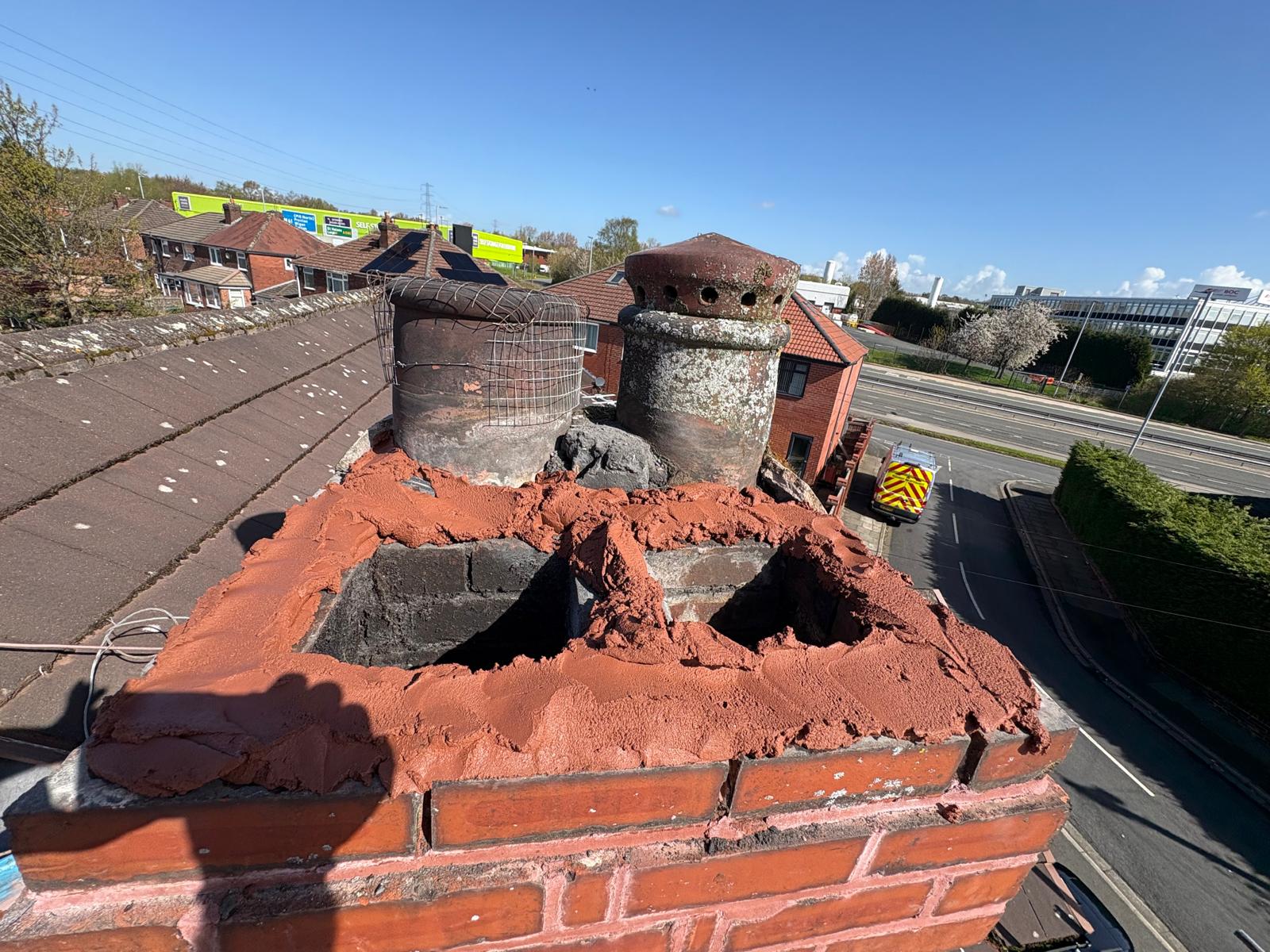
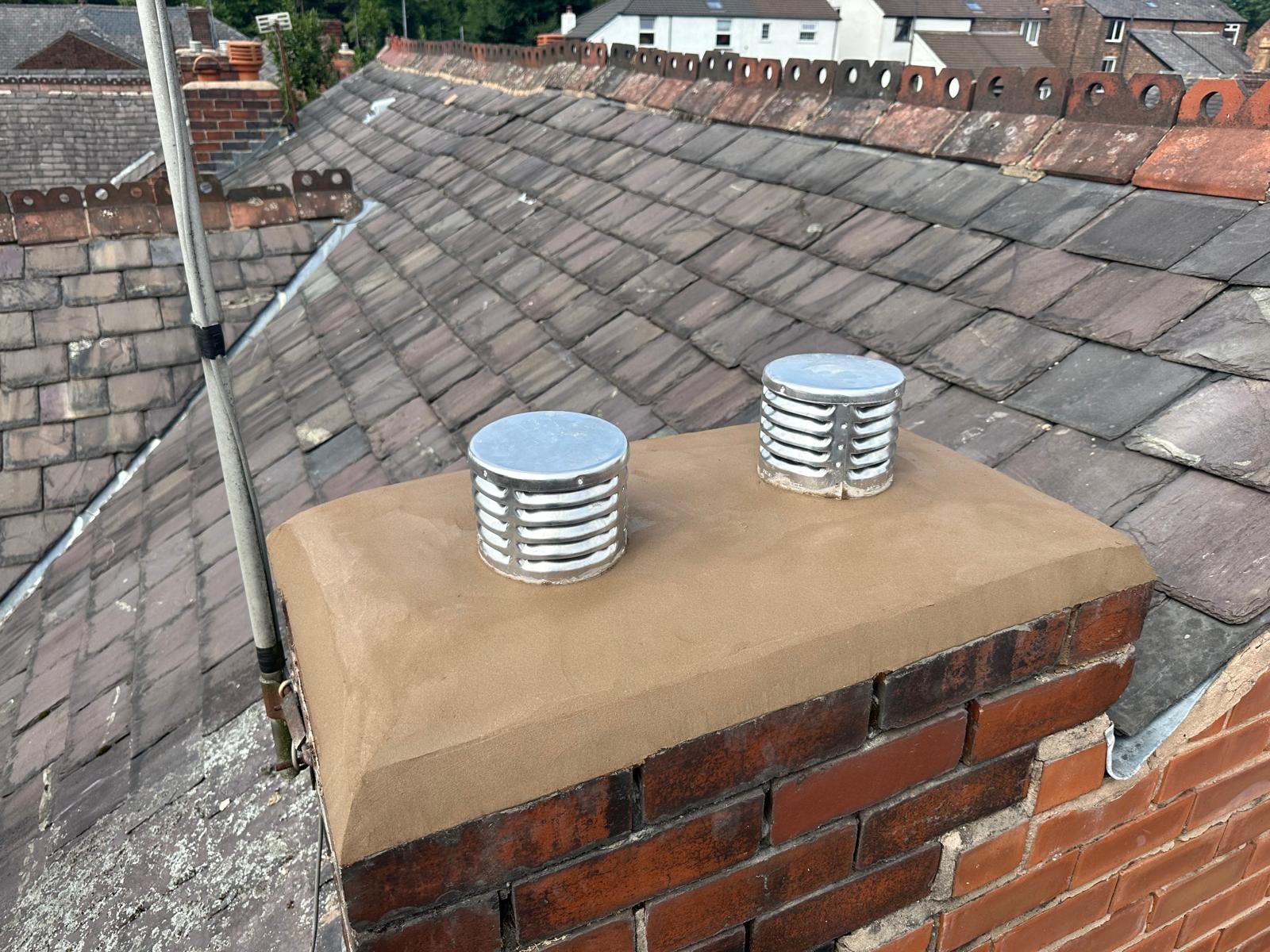
The flaunching goes first. That is the sloped mortar cap holding the pots in, the most weathered mortar on the house. It cracks, water sits in it, freezes and opens it further, and the top of the stack starts taking water in. The pointing follows on the weather face, and once a joint is soft the brick face spalls off in the next frost. The lead is worked by every temperature change: dressed too long in one piece it splits along the fold, and a cement fillet used instead of lead cracks away from the brick.
Damp on the chimney breast
This one gets misread, and it is expensive to misread. A damp patch on a chimney breast, usually upstairs and usually to one side rather than the middle, is nearly always water off the stack. It is not rising damp: it is too high up and there is no route for it. Salts left in the old soot make it worse, because they pull moisture out of the air and hold it, so the patch grows and shrinks with the weather. Chemical damp courses get sold for walls whose real fault is a cracked flaunching. Sort the top of the stack and the wall dries out.
How to check your own stack
From the ground, with binoculars if you have a pair. Look at the top for a cracked or missing cap round the pots, and down the weather face for joints that are dark, hollow or mossy. Look where the stack meets the roof for lead that has lifted, or a cement fillet where lead should be. Inside, put a hand on the breast after a wet week and again after a dry one: a patch that changes with the weather comes from outside. Do not lean a ladder on the stack itself.
The lead details, and what each one is for
Where a stack comes through a pitch the front takes an apron over the tiles, the sides a stepped flashing cut into the mortar joints with a soaker under each course, and the back a back gutter, which is the detail most often missing and the one that leaks hardest. Behind a parapet it becomes a lined gutter with its own falls, and a lead tray in the brickwork stops water running down inside the stack. Lead is graded by code number, the heavier codes going where the piece is longest or the exposure worst, and every piece has to be short enough to move. We cut into the joint and wedge it rather than stick lead to the brick.
Not sure what you need? Call and we'll tell you straight.
150+ Google reviews. Dave has 25 years on the tools.
Shared stacks, sandstone and lime mortar
The terraces off Bolton Road, round Patricroft and through Farnworth nearly all share their stacks, so half the flashing you are looking at belongs to next door. We will knock on and do the whole stack rather than leave a joint down the middle of it, and it comes back as one free written quote. In Bury and towards Ramsbottom the stacks are sandstone, and the commonest thing we are asked to undo there is sand and cement pointing: harder than the stone, it traps moisture and the block face comes off instead. Those get repointed in a lime mix that lets the wall breathe. On the 1930s semis round Whitefield it is nearly always a mastic patch where an apron should be.
If the lead has been stolen
It still happens, usually to a stack flashing, a bay roof or a valley seen from a back entry. Do not climb up to look. Get a cover over it before the next rain, because an open flashing line puts water into the head of the wall. We can sheet a stripped detail and come back and lead it properly. Where a run has been taken twice, terne coated stainless or a lead substitute is worth talking about: neither is worth anything to whoever took the first lot.
Where we stop, and why
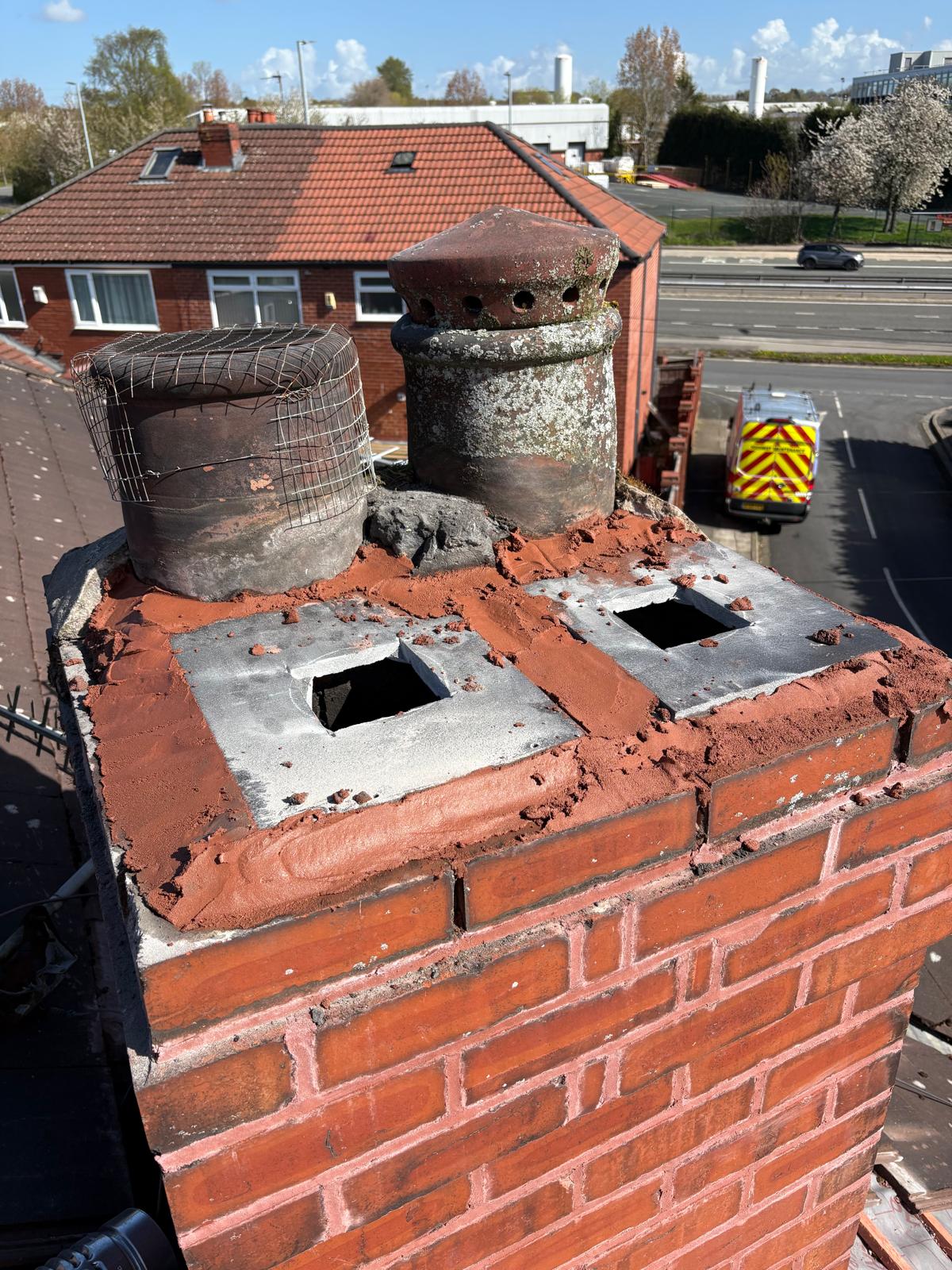
Everything above is fabric: brickwork, mortar, flaunching, pots, trays and lead. The moment work touches what a flue does, it stops being roofing. Lining or relining a flue, capping one that still serves a fire or a boiler, and taking a chimney breast out of a room are all somebody else's ticket, under Approved Document J or a structural engineer, and we do none of them. What we will do is fit a vented cowl to a flue that is out of use, and take a redundant stack down to the roof line. If there is a working appliance on that flue, the conversation starts with the engineer who services it.
Repoint or rebuild, and what affects the price
Repointing is right while the bricks are sound and the stack is plumb. A rebuild from the roof line up is the answer when it is leaning, when the brick faces have spalled so there is nothing to point into, or when a previous repair was built off a soft joint. The variables are the height of the stack above the ridge, how far down it comes, whether brick or stone has to be matched, and how many lead details are renewed at once. Access surprises people: a stack behind the ridge on a steep pitch is a scaffold job whatever the size of the repair. Dave sets it out in a free written quote.
Areas we cover for chimney repair and leadwork
Related services
Guides on this work
Frequently Asked Questions
Get a free quote today
150+ Google reviews. Dave has 25 years on the tools.
Free written quote with no obligation.