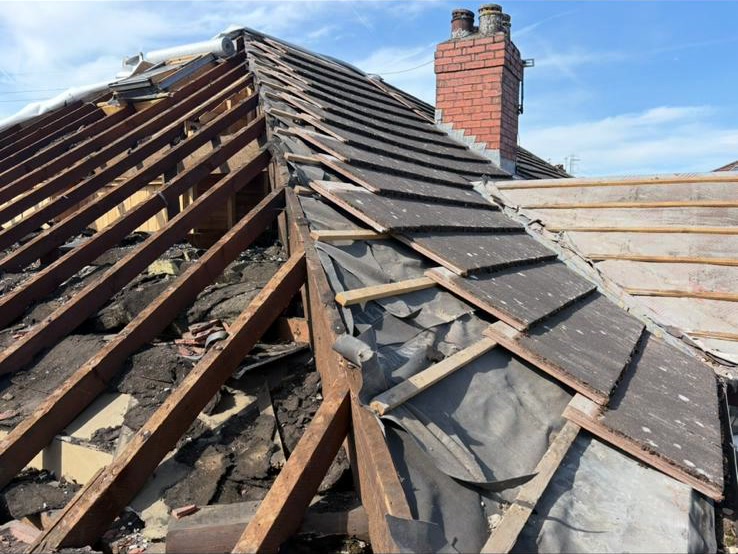
A Tile Came Off In The Wind
A tile that has come off in the wind rarely travels alone. The gust that took one has lifted its neighbours too, and the ones still on the roof have often moved without falling. Before anyone puts a tile back, the job is to find out what else has shifted and to record it while the evidence is fresh.
Key takeaways
- One tile down usually means several disturbed. The visible loss is the least of it.
- Photograph everything before it is tidied away, including the tile on the ground and where it landed.
- Wind damage is one of the few roof problems that home insurance commonly does consider.
- Check the ridge and the gable edge first, because wind lifts hardest at the edges of a roof.
- The roof is more vulnerable to the next storm than it was to the last one, so a temporary make safe is legitimate.
What the wind actually did
Wind does not push tiles off a roof so much as suck them off. As air crosses the roof it accelerates and its pressure drops, creating lift on the outer surface, while air forced into the roof space through eaves and gaps pushes outward from beneath. A tile is caught between the two. The effect is strongest at the perimeter, meaning the ridge, the gable verge and the eaves, and weakest in the middle of a large slope. That is why storm damage nearly always begins at an edge and works inward, and why the single tile you found on the lawn is a poor guide to the extent of what happened above.
The first hour: evidence, not repairs
Before anything is tidied, photograph the tile where it landed, the gap it left on the roof, the surrounding area of the slope, and any debris in the garden or gutters. Take wide shots that establish the whole elevation and close shots with full zoom on the damage. Note the date and, if you can, the time the damage was noticed. Weather records for the day are freely available afterwards and will show wind speeds, which matters because insurers apply thresholds. This record costs nothing and takes ten minutes, and it cannot be recreated once the tile has been thrown in a skip and the roof has been repaired.
What else to look for, from the ground
Work along the roof in sections with a zoomed camera. Look for tiles sitting slightly proud, lifted at one edge, or out of line with their course, because a tile that has been lifted and dropped back rarely reseats properly. Look along the ridge for gaps or displaced tiles. Look at the gable edge for missing mortar or a tile that has moved outward. Look at the flashings around the chimney for lead that has lifted. Then look at the neighbouring houses on the same terrace or street, which took the same wind: if three roofs nearby show similar damage, that supports the case that this was a weather event rather than wear.
Making it safe versus repairing it
These are two different jobs and it is worth knowing which one you are buying. Making safe means stopping further water entry and removing anything that could fall, typically with a temporary cover, and it is a reasonable thing to do quickly in bad weather. A permanent repair means matching tiles, checking battens and fixings, and putting the covering back properly, and it wants dry settled conditions to be done well. A make safe in a gale followed by a proper repair the following week is a sensible sequence and not a sign anybody is padding the work. What is not reasonable is a permanent repair invoiced for work done in conditions where it cannot have been done properly.
Not sure what you need? Call and we'll tell you straight.
150+ Google reviews. Dave has 25 years on the tools.
The insurance question
Storm damage is one of the few roof events that policies commonly cover, unlike gradual deterioration and general maintenance which are usually excluded. Insurers typically test whether wind speeds reached a threshold on the date claimed, and whether the roof was in reasonable condition beforehand. That second test is where claims most often fail: if the roof was already at the end of its life, an insurer may argue the wind merely finished what age had started. Contact your insurer before authorising anything beyond making the property safe, ask specifically what evidence they want, and keep the damaged tile rather than disposing of it, because it is physical evidence of how the failure occurred.
Matching the tile, which is harder than it sounds
Roof tiles change over the decades. Profiles are discontinued, colours weather, and manufacturers come and go, so a modern tile of the same nominal type can sit visibly proud or read as a bright patch on a weathered roof. Good practice on a small repair is to take matching tiles from a less visible elevation, such as a rear slope or behind a chimney, and put the new ones there instead, so the visible face of the roof stays consistent. Salvage yards are the other source for older profiles. If somebody proposes to fill the gap with whatever is on the van, ask what it will look like from the street in a year.
Why it is more vulnerable now than before the storm
Every roof covering relies on overlap, and overlap works in both directions: each tile protects the one below from water and helps hold down the one beside it against lift. Remove one and its neighbours have lost part of their restraint and are more exposed to the next gust. This is the real argument against leaving a gap over winter and waiting to see. The second storm typically does more damage than the first, not because it is stronger but because it arrives at a roof that has already been opened. If a full repair has to wait, a temporary secure cover is worth having in the meantime.
What a proper post storm inspection covers
The covering, obviously, but also the ridge and hip fixings, the verge, the flashings at every junction, the state of the underlay where it is now visible through any gap, the gutters and downpipes for displaced material, and the loft from inside for daylight and for wet timber. Expect photographs of each, because you are commissioning an assessment of a surface you cannot see and photographs are the deliverable. If the roof turns out to have widespread nail or batten failure rather than storm damage alone, it is better to learn that during the inspection than after paying for three individual tile repairs across three winters. It is also worth asking whether the tiles that stayed on have been checked for cracks rather than only for position. A tile can be lifted and dropped back looking perfectly seated while carrying a hairline crack through it, and those fail quietly over the following year in ordinary rain rather than dramatically in the next gale. A roofer walking the roof can find them; nobody can see them from the ground. The same applies to the fixings: a nail that has been pulled part way out by a lifted tile leaves that tile seated but no longer secured, and it will be among the first to go in the next storm.
Frequently Asked Questions
Related services
More from the blog
About the author
David Boardman founded Boardman Roofing in 2018. Dave has 25 years on the tools. Read 150+ Google reviews or call 07879 736629.
Get a free quote today
150+ Google reviews. Dave has 25 years on the tools.
Have a roof problem you want a real roofer to look at? Free written quote, no pressure.