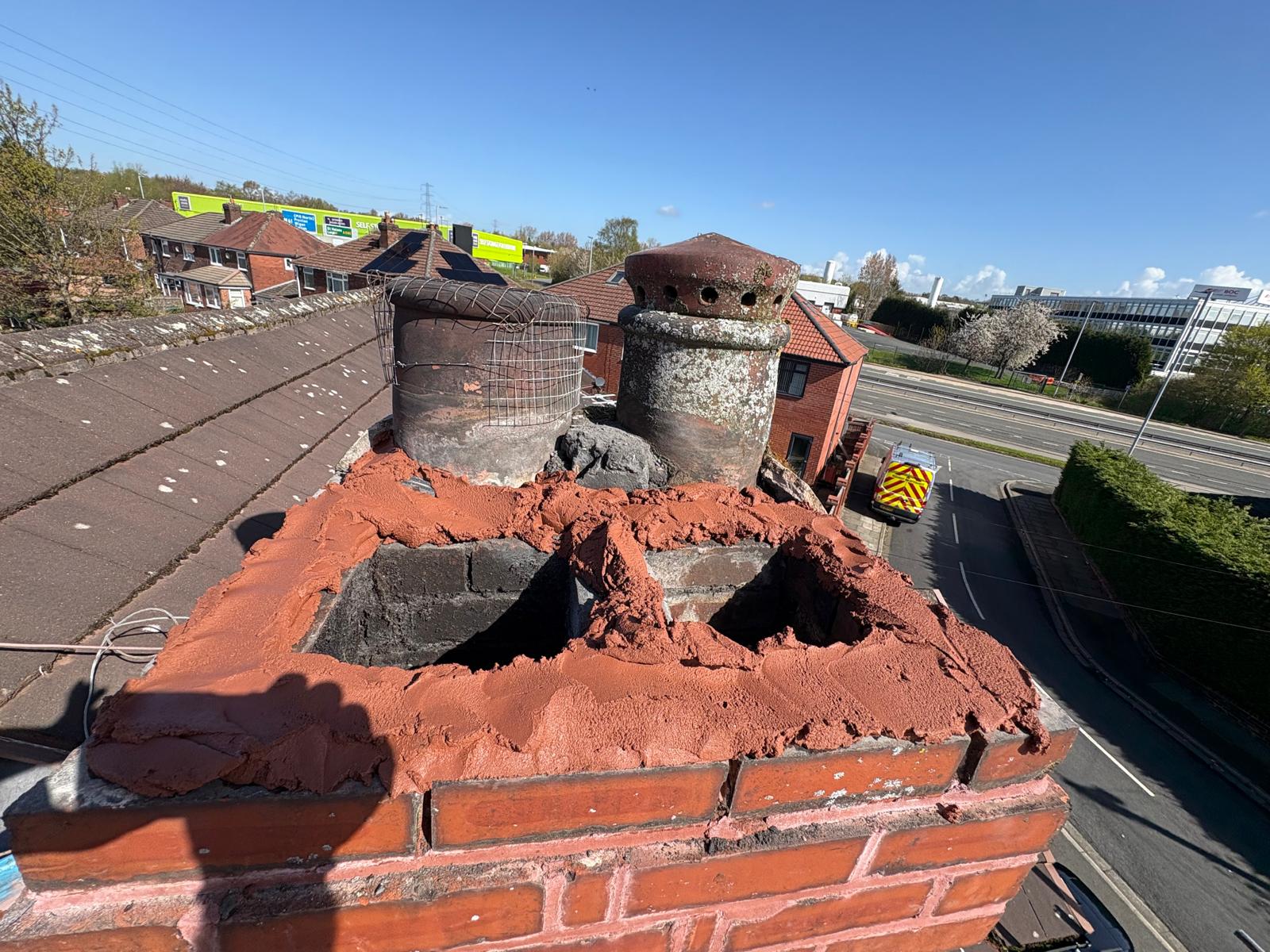
A Cracked Cement Fillet Around The Chimney
A cement fillet is the grey wedge of mortar sometimes used around the base of a chimney where lead should be. It is a substitute, not a detail, and it fails for a reason that never goes away: cement and the roof around it move at different rates, so it cracks, and a crack in a wedge collects water rather than shedding it.
Key takeaways
- A fillet is a triangular mortar wedge sealing a junction. Correct practice at a chimney uses lead instead.
- It cracks because the roof moves daily and rigid cement cannot follow it.
- Once cracked it is worse than nothing, because the crack channels water into the joint and holds it there.
- Repointing or sealing the crack lasts a season or two and then reopens in the same place.
- It is very common on Greater Manchester terraces, usually as a cheap repair done decades ago.
What you are looking at
Stand back from the house and look at where the chimney stack emerges from the roof slope. If the junction is a smooth grey triangular ramp of mortar running along the base of the brickwork, that is a cement fillet. If instead you can see a folded metal apron across the front, stepped pieces up the sides and a hidden section behind, that is leadwork, which is the correct treatment. Fillets were used because they are quick, cheap and require no leadworking skill, and they were applied in enormous numbers across British housing during the twentieth century, often as a repair over failed lead rather than as an original detail.
Why it always cracks eventually
Three materials meet at that junction and all three behave differently. The brick stack heats up and cools down, the tiles or slates expand and contract, and the roof structure beneath flexes with load and moisture. Cement mortar is rigid, has almost no capacity to accommodate that differential movement, and is bonded to both surfaces at once. The result is not a question of whether but when. It cracks first as a hairline along the line where mortar meets tile, because that is the weakest bond, and then opens with successive winters as water gets in, freezes and expands. Nothing about the workmanship prevents this, which is why even a well made fillet is a temporary solution.
Why a cracked fillet is worse than no fillet
This is the part that surprises people. An open junction with no fillet at all would shed most water simply because it is a gap facing downhill. A cracked fillet is a wedge with a channel in it: water runs along the crack rather than off the surface, is held there by capillary action, and is delivered directly into the joint between the stack and the roof. The fillet also conceals whatever is underneath, so a homeowner looking from the ground sees a solid grey ramp and concludes the junction is sealed. This combination, water being actively directed inward while looking sealed from below, is why fillets show up so often in the history of a persistently damp chimney breast.
The repair that keeps coming back
The obvious response to a cracked fillet is to fill the crack, or to rake it out and repoint it, or to paint the whole thing with a bituminous or acrylic sealer. All three are common and all three fail in the same way, because none of them addresses the reason it cracked. Differential movement is still there the day after the repair. A sealed crack reopens, typically along the same line, usually within two or three winters. Worse, a coating over the top traps moisture in the mortar beneath, which accelerates frost damage. If the history of your chimney includes two or three episodes of somebody sealing the fillet, that history is the argument for doing it properly rather than a fourth time.
Not sure what you need? Call and we'll tell you straight.
150+ Google reviews. Dave has 25 years on the tools.
What should be there instead
A correctly detailed stack has several separate pieces of lead. A front apron dressed over the tiles on the downhill face. Step flashings or soakers up each side, following the brick courses and cut into the mortar joints. And a back gutter behind the stack, which is the piece most often missing and the one carrying the most water, since everything coming down the slope above arrives there. Each piece is fitted in a length short enough to move freely, and each is wedged into a raked out joint and pointed. Replacing a fillet with this arrangement is a proper job requiring access and skill, and it is the difference between a junction that lasts decades and one that needs revisiting.
Judging the condition from the ground
Photograph the stack with full zoom from two or three angles. You are looking for a visible crack line along the junction between mortar and roof surface, sections where the fillet has come away entirely leaving an open gap, crumbling or flaking mortar, and plant growth along the line, which indicates held moisture. Look also at the tiles immediately below the stack for staining, and at the brickwork of the stack itself for a darker damp band near the base. Inside, note whether the damp on the chimney breast worsens after rain, which points at this junction, rather than being constant, which points at salts within the plaster instead.
The timing on this one
A cracked fillet is not an emergency and it can generally wait for settled weather, which lead work needs anyway. What it should not do is wait indefinitely, and the reason is what sits underneath. Water entering at that junction runs into the roof structure at the point where rafters meet the stack, and prolonged wetting there rots timber that is awkward and expensive to reach. So the sensible window is the next dry spell rather than the next emergency. Bring it forward if damp inside is spreading, if plaster is blowing off the chimney breast, or if the fillet has already lost whole sections rather than merely cracked.
What to ask when getting it priced
Ask specifically whether the quote is to replace the fillet with lead or to repair the fillet, because those are very different jobs at very different prices and both may be offered without the distinction being made clear. If it is lead, ask whether a back gutter is included, since that is the piece most commonly omitted and the one that matters most. Ask what code of lead and in what lengths. Ask how the stack will be accessed, as scaffold or a tower is usually necessary and dominates the cost. And ask for photographs from up there, since this is a part of the house you have only ever seen through a zoom lens. One last consideration is whether the stack is worth keeping at all. If it serves no working fireplace, is in poor order, and the roof is due for other work anyway, removing it down to below the roof line and making good can cost less than a full lead and rebuild, and it removes a maintenance item permanently. That is a decision to take deliberately rather than under pressure, but it belongs in the conversation, particularly if the stack is one of several on the house and the others are in the same condition.
Frequently Asked Questions
Related services
More from the blog
About the author
David Boardman founded Boardman Roofing in 2018. Dave has 25 years on the tools. Read 150+ Google reviews or call 07879 736629.
Get a free quote today
150+ Google reviews. Dave has 25 years on the tools.
Have a roof problem you want a real roofer to look at? Free written quote, no pressure.