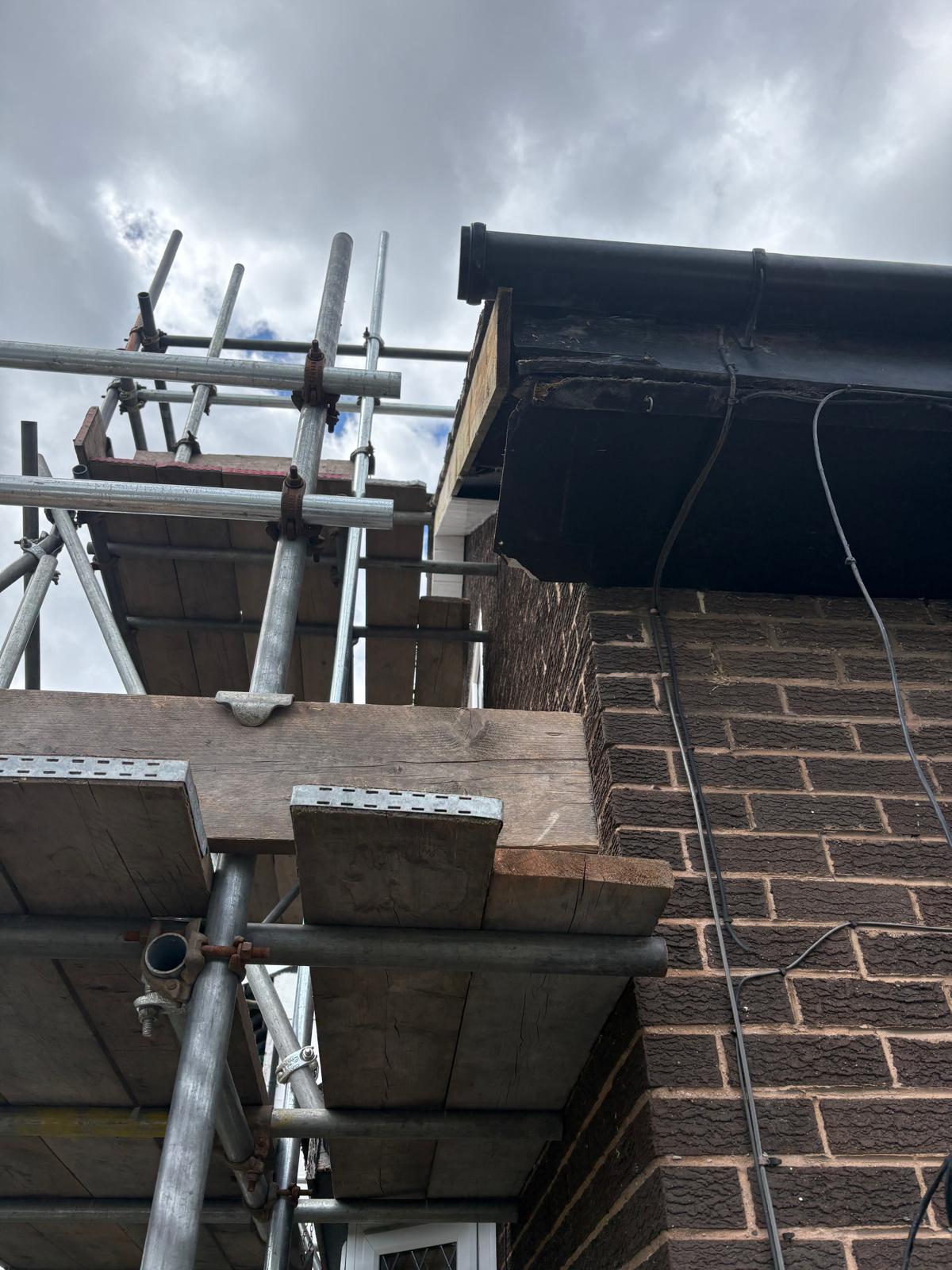
Damp Above A Bay Window
The roof over a bay window is the most neglected roof on a British house. It is small, invisible from the street, usually flat or nearly flat, and often has not been touched since the house was built. Damp on the wall above a bay almost always starts there rather than in the window below it.
Key takeaways
- A bay roof is a genuine roof in miniature, with its own covering, falls, flashing and drainage, and it fails in all the same ways.
- Because nobody can see it from the ground, it typically gets no maintenance at all until damp appears inside.
- The junction where the bay roof meets the main wall is the usual entry point, not the middle of the bay roof.
- Original bay roofs on Victorian and 1930s houses are frequently lead or felt that is now well past its expected life.
- The damp usually shows on the wall above or beside the bay rather than directly below the defect.
Why bay roofs fail so reliably
A bay projects from the main wall, which means its roof has to shed water and then hand it over to a wall junction that relies on flashing. It is small, so it collects less water than a main roof, but it also has proportionally far more edge and junction per square metre, and edges are where roofs leak. It is usually laid to a very shallow fall, which makes it slow to drain and prone to holding water and debris. It sits below the main roof, so anything that comes off the slope above lands on it, including grit washed out of tiles and leaves from any nearby tree. Add the fact that it is out of sight and therefore out of mind, and the failure rate is entirely predictable.
The wall junction, and why it is the usual suspect
A bay roof hands its water over to the main wall, and the handover relies on metal folded up the brickwork and buried in a raked out joint, with the covering beneath lapped under it. On older properties this is often lead, and lead does not fail so much as its fixings and pointing do: the mortar holding the top edge crumbles, the lead relaxes away from the wall, and a slot opens up. On cheaper repairs the flashing has been replaced with mastic or a bituminous paint, both of which have a short life in full sun and then crack. Once that junction is open, every shower puts water directly into the wall head above the bay, which is exactly where the internal damp appears.
What the covering is, and why that matters
Original bay roofs are commonly lead, zinc or bitumen felt, depending on the age and the budget of the original build. Lead lasts a very long time when it has been laid in correctly sized panels with allowance for movement, and it fails early when it was laid in oversized sheets that then crack from thermal stress. Felt has a much shorter life, typically fifteen to twenty years, and it perishes visibly: it goes brittle, it develops crazing, and it splits at the upstands first. Modern replacements are usually a single ply membrane, EPDM rubber or fibreglass, all of which perform well provided the detailing at the wall and the edge is done properly. Knowing which one you have tells you whether you are looking at a repair or a replacement.
The parapet and the hidden gutter
Many bays, particularly on Victorian and Edwardian properties, have a small upstand or parapet around the edge, with a concealed gutter or a lead lined channel behind it. That arrangement looks tidy from the street and creates a trap: if the outlet blocks, the water has nowhere to go but inward and upward, over the flashing and into the wall. These hidden gutters silt up with moss and grit from the main roof above, and because nobody can see them, they can be completely blocked for years. If your bay has a raised edge rather than a simple overhanging one, blockage should be near the top of the list of suspects.
Not sure what you need? Call and we'll tell you straight.
150+ Google reviews. Dave has 25 years on the tools.
Ruling out the window itself
It is worth being fair to the window before condemning the roof. A failed sill, a perished seal or a blocked drainage channel in a modern frame can all produce damp around a bay, and the pattern is different: window related damp appears at the sides and below the frame, and it tends to be localised to one opening. Roof related damp appears above the window head and across the width of the bay, and it often affects the ceiling of the room as well as the wall. If the damp is highest at the top and spreads down, look up. If it starts at the sill and works up, look at the window.
What you can see from the ground and from inside
From an upstairs window in the same house you can often look directly down onto your own bay roof, which is the single most useful view available and requires no ladder at all. Look for standing water, moss, a split or crazed surface, debris piled against the wall junction, and whether the flashing sits flat against the brickwork or has lifted away. From the street, look at the brickwork above the bay for a permanent damp stain or a green algae streak, which marks where water habitually runs. Inside, note whether the damp worsens after rain and whether it is worst at the top of the wall.
How long a bay roof can safely be left
Most bay roof damp can wait for a planned repair in dry weather, and doing it properly in settled conditions is better than a wet weather patch that will not adhere. Move it up the list if the ceiling inside is stained or sagging, if timber at the bay head feels soft, if plaster is blowing off the wall, or if the bay roof is visibly holding water after every shower. Bay structures deserve a little more caution than a plain wall because the timber inside them is often original, poorly ventilated and difficult to inspect, so prolonged damp there can quietly become a structural repair rather than a covering repair.
Repair or replace
If the covering is sound and the fault is at the junction, renewing the flashing and repointing is a modest job and the right answer. If the covering itself is perished felt, crazed across its surface or splitting at the upstands, patching is a short term measure and replacing the covering is usually better value, because most of the cost is access and preparation rather than the material. Whatever is done, the detail at the wall matters more than the material chosen: a good membrane with a poor upstand will leak, and a modest covering with a properly dressed and pointed flashing will not. Ask specifically how the wall junction will be formed, because that answer tells you whether you are buying a repair or another few years of the same problem. It is also sensible to have any hidden gutter behind a parapet cleared and checked as part of the same visit, since access is the expensive part and nobody will want to come back for it.
Frequently Asked Questions
Related services
More from the blog
About the author
David Boardman founded Boardman Roofing in 2018. Dave has 25 years on the tools. Read 150+ Google reviews or call 07879 736629.
Get a free quote today
150+ Google reviews. Dave has 25 years on the tools.
Have a roof problem you want a real roofer to look at? Free written quote, no pressure.