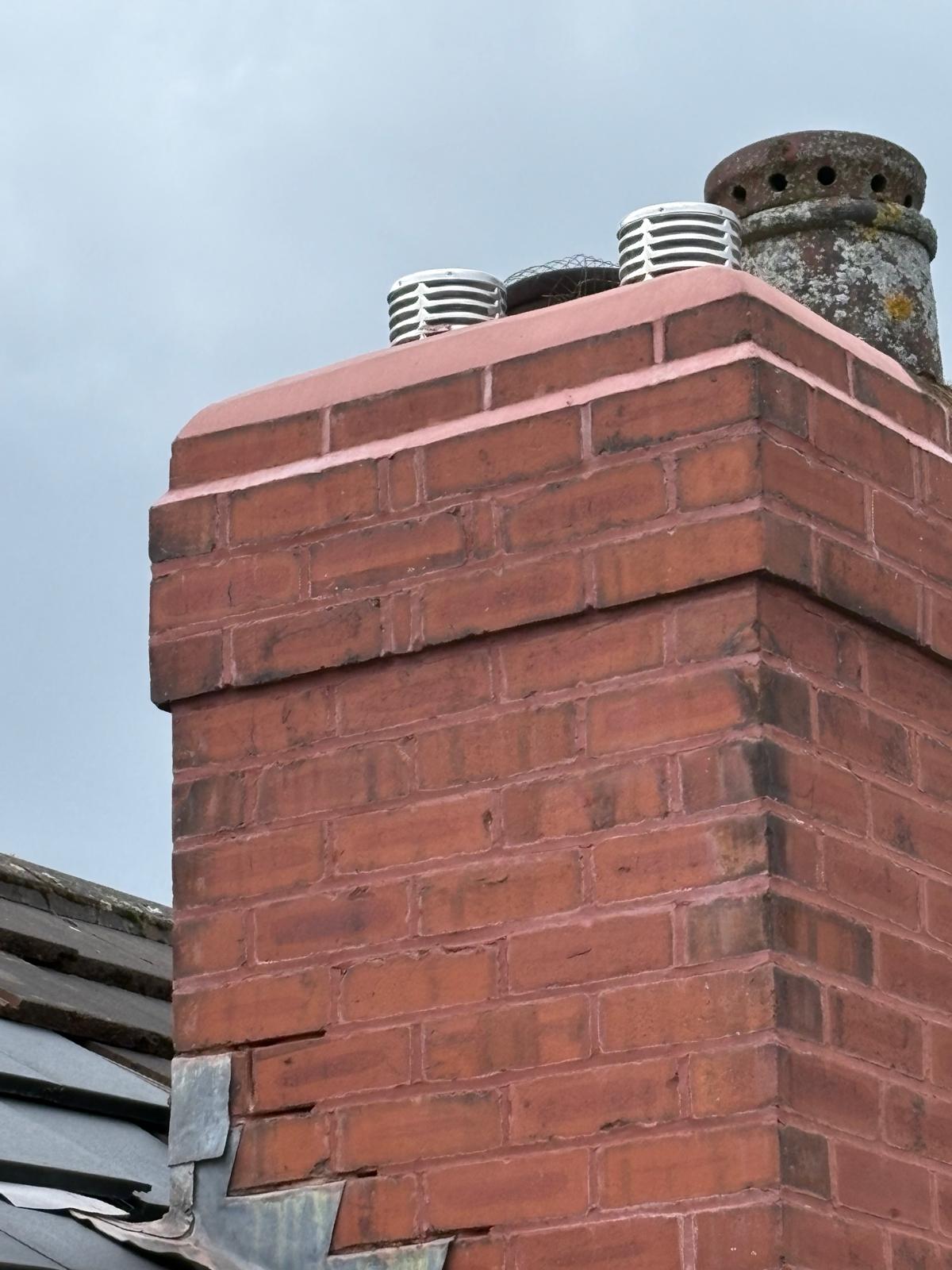
Lead Flashing Coming Away From A Wall
Lead that has pulled away from a wall has almost always been let down by the mortar holding its top edge, not by the lead itself. Lead lasts for generations. The pointing that wedges it into the brickwork lasts a few decades, and when that goes the whole strip relaxes outward and opens a slot.
Key takeaways
- Lead outlives almost everything else on a roof. It is the fixing and the pointing that fail first.
- The top edge should sit in a raked out mortar joint, held by wedges and pointed over. If it is stuck to the face of the brick, it was never right.
- Lead moves a great deal with temperature, so it must be fitted in short lengths with laps.
- A single continuous strip along a long wall will buckle and split within a few years however well it is fitted.
- White powdery deposits on the surface are usually harmless oxidation, not failure.
Why lead is used at all
Every point where a roof surface meets something vertical needs a material that can be shaped to fit an irregular junction, tolerate constant movement, and last a very long time outdoors. Lead does all three. It can be dressed by hand into the exact profile of a tile or a brick course, it is soft enough to absorb thermal movement without cracking, and it does not rot, rust or perish in sunlight. This is why you find it at chimneys, at abutments where a lower roof meets a wall, in valleys, around dormer cheeks, at parapet gutters and around soil pipes. When people say a roof leaks at a junction, it is very often lead they are talking about.
How the top edge should be held
The upper edge of a flashing is turned into a horizontal mortar joint that has been raked out to a depth of around twenty five millimetres, held there with folded lead wedges driven in at intervals, and then pointed over to close the joint. That arrangement means the flashing is mechanically captured by the wall, and the pointing is only weatherproofing rather than the thing holding it up. When you see lead that has relaxed outward into a curve, that captured edge has been lost: either the pointing has weathered away and the wedges have dropped out, or there were never any wedges and the pointing alone was doing the work.
The shortcut that always means a return visit
The most common defect found at a flashing is not damage at all, it is an installation that skipped the chase. Instead of cutting into the mortar joint, the lead has been laid against the face of the brickwork and sealed along its top edge with silicone or a bituminous compound. It looks convincing for a season or two. Then ultraviolet light degrades the sealant, thermal movement works the joint, and the bond to porous brick lets go, at which point water runs behind the flashing instead of over it. The visual test is simple: a correctly fitted flashing disappears into a line in the brickwork, while a shortcut one stops at a visible bead sitting on the surface.
Length, and the mistake that splits lead
Lead expands and contracts substantially with temperature, far more than the masonry it is attached to. Fitted in short lengths with laps between them, each piece moves independently and the laps accommodate the difference. Fitted as one long continuous strip, the movement has nowhere to go, so the sheet buckles, work hardens along the fold lines, and eventually splits. Established guidance limits individual pieces to around one and a half metres for most flashing work. This is why a flashing that looked immaculate on the day it was done can be rippled and cracked three years later, and it is a workmanship failure rather than bad luck.
Not sure what you need? Call and we'll tell you straight.
150+ Google reviews. Dave has 25 years on the tools.
Thickness, and why some flashings fail early
Lead sheet is supplied in codes, numbered by thickness, with higher numbers being thicker. Flashings on a house are normally code four or code five, and using something thinner because it is cheaper and easier to dress is a false economy that shows up as tearing at the folds and at the fixing points. You cannot easily tell the code from the ground, but if a flashing has torn along a crease or split around a wedge rather than simply relaxing away from the wall, thin material is a likely part of the story. Worth asking about specifically when getting a quote, since it is one of the few things where the specification is a simple number.
What is worth worrying about and what is not
White or pale grey powdery deposits on the surface of lead are normal oxidation and generally harmless, though heavy staining running down brickwork below can be a cosmetic nuisance. Slight rippling along a length is common and not in itself a failure. What matters is whether the top edge is still captured in the wall, whether there are splits or tears, particularly along fold lines, and whether any section has lifted enough to leave a gap you can see daylight through. Also worth noting is any place where the flashing has been patched with mastic, since that usually marks a previous failure at that exact point rather than a solution to it.
How long this can be left
A flashing that has relaxed but is still broadly in place, on a wall that is not showing damp inside, can wait for a planned dry spell, and lead work genuinely needs dry conditions and unhurried access to be done properly. Move it up the list once damp appears on the inside of that wall, once you can see a gap rather than just a curve, or once the affected junction is above a room rather than above a garage or an outhouse. Bring it forward regardless if the loose section is large enough that wind could get under it, because lead is heavy and a sheet peeling off a wall in a gale is a hazard as well as a leak.
Getting it repaired to last
The right repair takes the old flashing off, rakes out the joint properly, fits new lead of the correct code in appropriate lengths with laps, wedges it, and points it in with a mortar suited to the wall, which on an older building means a lime based mix rather than hard cement. It is skilled work and it is worth watching for one specific answer when getting quotes: ask whether the lead will be cut into the joint or sealed to the surface. That single question separates a repair that lasts decades from one that will be back within a few winters, and it also tends to reveal how the existing one was done. Worth knowing as well: lead is valuable and is stolen from buildings, most often from flat roof coverings and large parapet details rather than from small domestic flashings. It is not usually a consideration on a house, but if a property has substantial leadwork and sits somewhere secluded, it is a reasonable thing to raise when the work is specified, since some insurers ask about it and alternatives to lead exist for exposed positions.
Frequently Asked Questions
Related services
More from the blog
About the author
David Boardman founded Boardman Roofing in 2018. Dave has 25 years on the tools. Read 150+ Google reviews or call 07879 736629.
Get a free quote today
150+ Google reviews. Dave has 25 years on the tools.
Have a roof problem you want a real roofer to look at? Free written quote, no pressure.