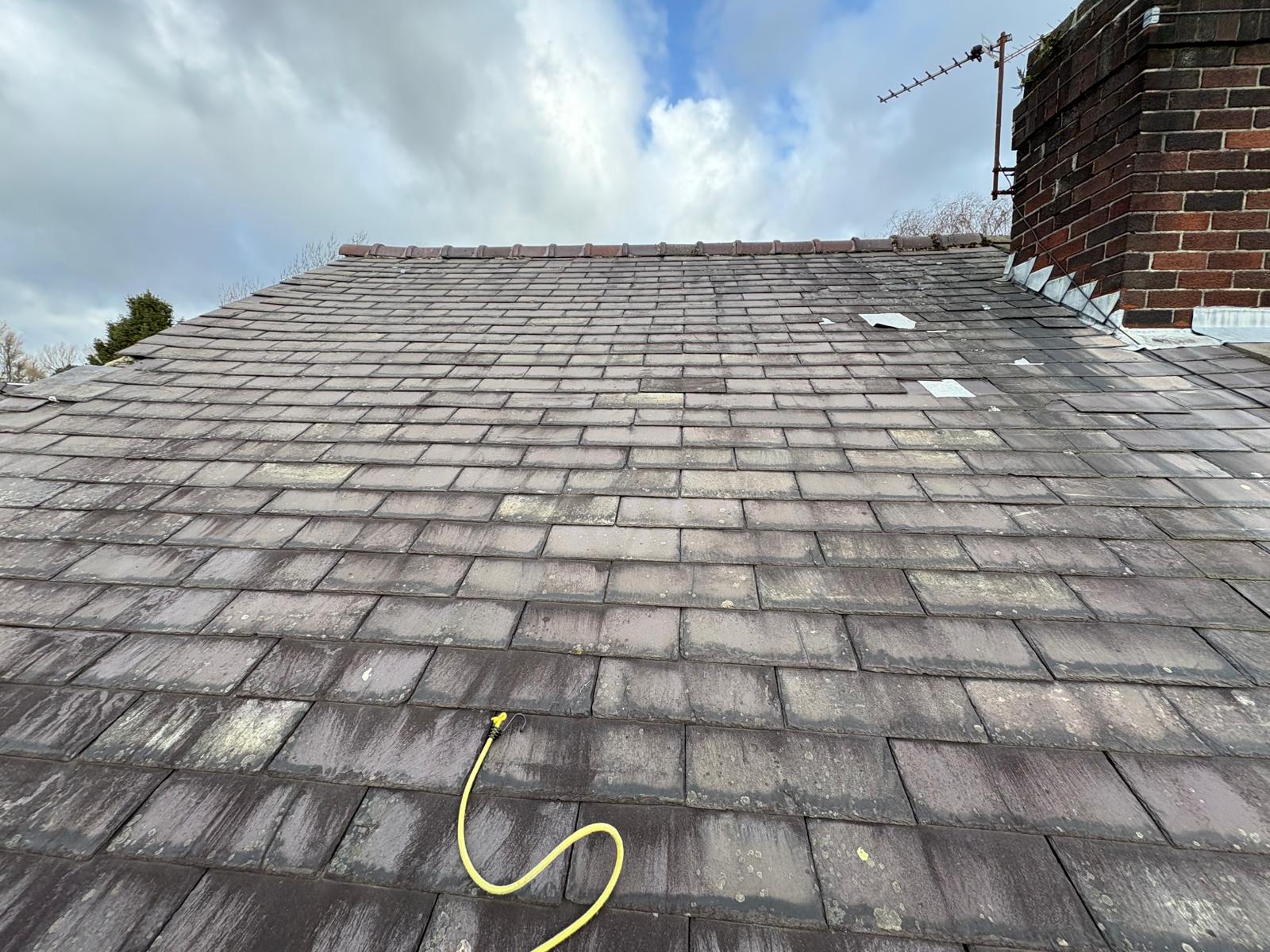
Selling A House With An Old Roof
Buyers discount a doubtful roof by more than it costs to put right, because they are pricing uncertainty as well as work. That is the arithmetic behind the question, and it is why the answer is often to establish the facts rather than either to replace the roof or to say nothing.
Key takeaways
- An unknown roof is discounted more heavily than a known one, whatever its actual condition.
- A roofer's report costs little and can remove the uncertainty a buyer would otherwise price in.
- Replacing a roof rarely returns its full cost in the sale price.
- Targeted repairs to the visible items often shift perception more than their cost suggests.
- You must answer buyer enquiries honestly, so concealment is both wrong and impractical.
What a buyer is actually pricing
When a buyer sees a tired looking roof, they do not deduct the cost of the repair. They deduct the worst plausible outcome, plus something for the disruption, plus something for the risk that there is more they cannot see. A roof that might need five thousand spent on it can easily take ten off an offer, because the buyer is protecting themselves against an unknown. That gap between actual cost and perceived risk is the entire opportunity here, and it is why information is frequently a better investment than work.
The report that closes the gap
Commissioning your own roofer's inspection, with photographs and a written assessment, is the highest return action available to most sellers with an older roof. If it comes back saying the covering is serviceable with some maintenance items, you have converted an unknown into a known and removed the buyer's justification for a large discount. If it comes back saying substantial work is needed, you have learned that before a buyer's surveyor tells you, which lets you decide how to handle it rather than reacting under time pressure in a chain. Either result is worth more than the cost of the report.
Whether to replace it
Generally not, purely for sale purposes. A new roof rarely returns its full cost in the price achieved, because buyers do not pay a premium for a component they expect to work, they only penalise one they doubt. There are exceptions: where the roof is visibly failing to the point of deterring viewings, where a lender would refuse to advance against it, or where the property competes directly with similar houses that have been done. Outside those, the money is usually better spent on establishing the facts and on targeted work that addresses what is visible.
What targeted work is worth doing
The items that change perception cost far less than a recovering. Replacing slipped or missing tiles removes the most obvious visual signal of neglect. Repointing or rebedding a ridge that has gaps in it does the same. Clearing gutters, valleys and downpipes so nothing is overflowing during a viewing matters more than it should. Dealing with moss where it is heavy and visible from the street changes how the whole house reads. And repairing any stained ceiling inside, after fixing whatever caused it, removes the single thing most likely to make a viewer imagine a leak.
The honesty requirement, which is not optional
During conveyancing you will complete property information forms and answer enquiries, and those answers must be truthful. Failing to disclose a known defect, or answering a question about damp or leaks inaccurately, can expose you to a claim after completion. Beyond the legal position it is also impractical: a buyer's survey is likely to identify anything significant, and a discrepancy between what you said and what they find damages trust at exactly the point where you need the transaction to proceed smoothly. Honest disclosure with a report attached is a far stronger position than silence.
Presenting a roof that has been repaired
If work has been done, the paperwork is an asset and should be assembled rather than mentioned. Quotations, invoices, any cover documents, manufacturer registrations and photographs of the work including anything now hidden. Put it together as a file, because a buyer presented with a documented history reads the house as maintained, whereas the same work described verbally reads as a claim. This is also why keeping records at the time matters: nobody assembles a credible file retrospectively, and the difference is visible to a buyer's solicitor immediately.
Not sure what you need? Call and we'll tell you straight.
150+ Google reviews. Dave has 25 years on the tools.
Dealing with a buyer's survey
Expect the roof to be commented on if it is old, because surveyors flag uncertainty as a matter of course. Having your own report already in hand transforms that moment: instead of reacting to somebody else's characterisation with no information, you can respond with an independent assessment you commissioned before the property was marketed. Where the buyer's surveyor recommends further investigation and your roofer has already investigated, you are answering a question rather than conceding a point. Where they disagree, at least the disagreement is between two professionals rather than between a document and your opinion.
When a buyer asks for money off
It will happen, and it is a normal part of the process rather than an accusation. The position to be in is one where you can respond with specifics: this is what our roofer found, this is what it costs, here is the report. From there, the options are to reduce by the assessed figure, to arrange the work yourself before completion, to offer a retention held by solicitors, or to hold firm because the price already reflected it. All of those are more comfortable than negotiating from a position where the only figure in the room is the one the buyer's surveyor guessed at.
The lender problem, which is the one to check for
The situation that genuinely blocks a sale is a lender declining to advance, or retaining part of the advance, because their valuer considers the roof defective. That is not a negotiation, it is a condition, and it means the buyer cannot complete without either doing the work or finding the money elsewhere. If the roof is at the stage where that is plausible, particularly with visible failure or evidence of water ingress, it is worth establishing before marketing, because discovering it three weeks before an intended completion is the worst possible timing.
The specific case of a very old covering
Where a roof is genuinely at the end of its life, and a report confirms it, being straightforward about it is usually the better strategy. Price the property accordingly, disclose the report, and let buyers see that the cost is known and bounded rather than open ended. Buyers are considerably more comfortable with a defined problem than an undefined one, and a house marketed as needing a roof at a price that reflects it attracts a different and often more decisive buyer than the same house marketed as though nothing were wrong and then discovered by survey.
The sequence that works
Before marketing, get your own roofer's inspection with photographs and a written report. Carry out the targeted visible items: slipped tiles, ridge gaps, gutters, moss where it is prominent, and any internal staining once its cause is fixed. Assemble the paperwork for anything ever done to the roof. Decide, with the report in hand, whether the price reflects the condition. Then market, disclose honestly, and respond to the buyer's survey with your own document rather than with an opinion. The cost of that sequence is small set against what an unanswered survey comment can take off the agreed price.
The mistake to avoid entirely
There is one approach that reliably makes things worse, and it is doing cosmetic work intended to disguise rather than to fix. Painting over a ceiling stain without addressing what caused it, having moss removed from a roof that is failing underneath, or applying a coating to a covering at the end of its life all fall into this category. Buyers survey houses, surveyors look in lofts, and recently applied cosmetic work on an older roof invites more suspicion than the original condition would have. It also converts an honest disclosure problem into a potential misrepresentation one, which is a considerably worse position to be in. If work is worth doing, it is worth doing as a repair with an invoice attached, since a documented repair is an asset in the sale, whereas the same money spent on disguise becomes a liability waiting to be discovered by somebody else at the least convenient moment in the transaction.
Frequently Asked Questions
Related services
More from the blog
About the author
David Boardman founded Boardman Roofing in 2018. Dave has 25 years on the tools. Read 150+ Google reviews or call 07879 736629.
Get a free quote today
150+ Google reviews. Dave has 25 years on the tools.
Have a roof problem you want a real roofer to look at? Free written quote, no pressure.