A Leak That Appears Hours After The Rain Stops
A leak that shows up hours after the rain has finished means the water is being stored somewhere before it reaches you. Something above the ceiling is holding it: soaked insulation, a pocket in the felt, a blocked valley or a full gutter. Finding the reservoir matters more than finding a hole.
Key takeaways
- Delay means storage. Water is collecting somewhere and releasing slowly rather than running straight through.
- Soaked loft insulation is the most common reservoir, and it can hold water for a day or more before it passes through the ceiling.
- A sagging pocket in old bitumen felt can hold litres of water and drip for hours after the sky clears.
- Blocked valleys and gutters back water up, then release it gradually as the blockage drains.
- The delay itself is a clue worth recording, because it points at a different set of causes to an immediate drip.
What a delay actually tells you
An immediate leak, arriving within minutes of rain starting, means a direct path: water enters and falls more or less straight onto the ceiling below. A delayed leak means the path includes something that fills up first. That distinction is genuinely useful, because it changes what you are looking for. Instead of hunting a hole directly above the damp patch, you are looking for a place where water can accumulate, and those places are limited in number and predictable in location. It also explains a pattern that confuses people: the leak that appears on a bright morning after a wet night, prompting the reasonable but wrong conclusion that it cannot be rainwater because it is not raining.
Reservoir one: the insulation
Mineral wool loft insulation is absorbent, and a two hundred millimetre depth of it across a ceiling can take up a great deal of water before any reaches the plasterboard. Water enters the roof, runs down a rafter, drops into the insulation and is held there. Only when that section is saturated does it start to pass through to the ceiling below, which can be many hours later. The insulation then stays wet long after the leak has stopped, which is why a single storm can produce several days of damp. It also means the wet patch on the ceiling appears wherever the insulation happened to be soaked, not below the entry point. Wet insulation loses most of its thermal value and does not recover, so it needs replacing rather than drying.
Reservoir two: a pocket in the felt
On older roofs, bitumen felt was laid across the rafters and it sags slightly between them by design. Over decades that sag deepens, and where the felt has torn or where a nail has pulled through, water running down the underside collects in the low point instead of continuing to the gutter. A well developed pocket can hold a surprising volume, and it drips steadily long after the rain has finished, exactly like a slow tap. If you can see into the loft from the hatch during wet weather, a bulging or glistening line of felt between two rafters is unmistakable once you know to look for it. It is also a strong indicator that the underlay has reached the end of its useful life.
Reservoir three: valleys and gutters
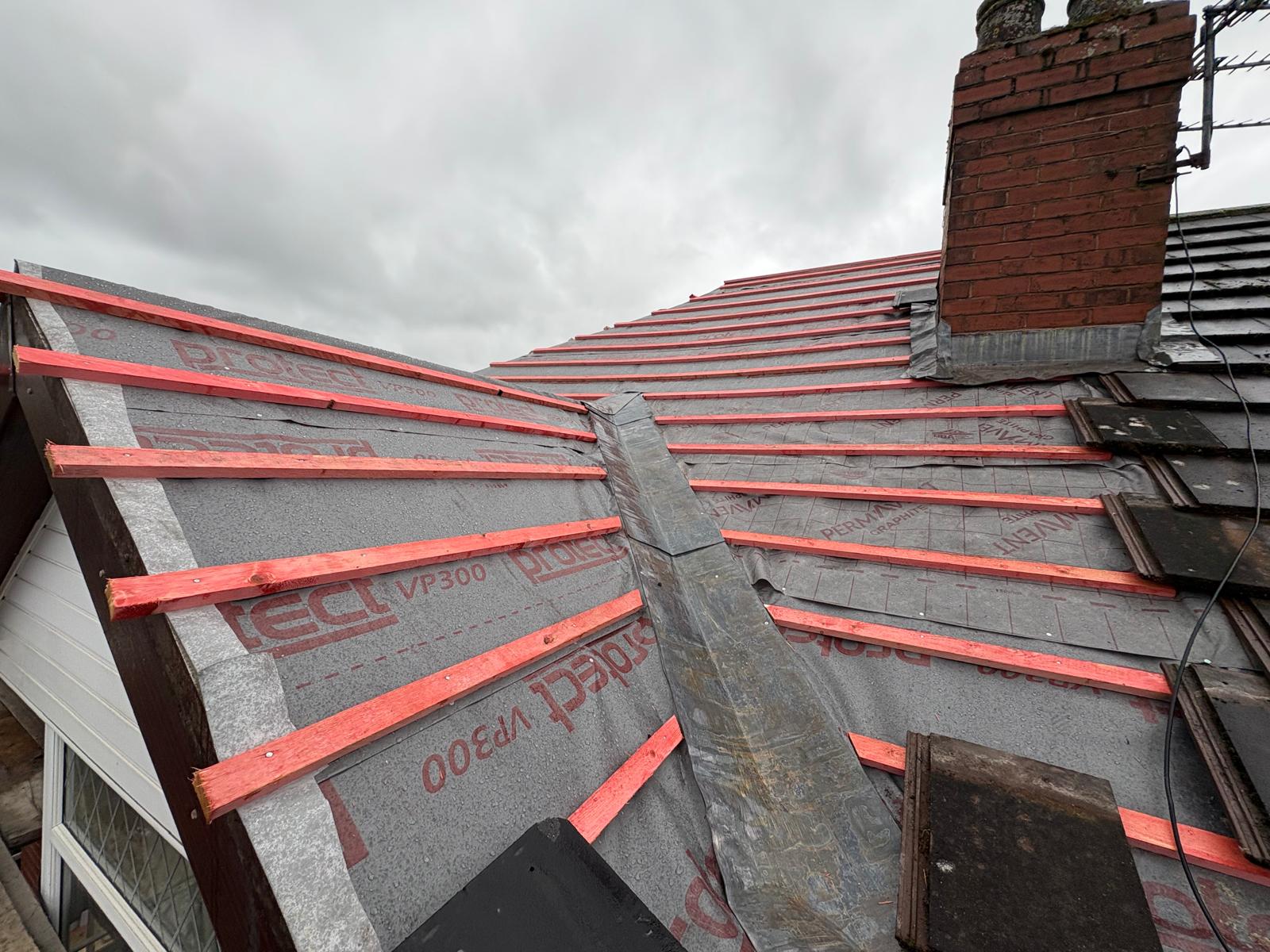
A valley clogged with moss, leaves or a slipped tile does not stop water, it slows it. Water backs up behind the obstruction, rises above the level the valley was designed to carry, and gets under the tiles on either side. When the rain stops, the backed up water drains gradually through the blockage and keeps feeding the roof for hours. A gutter behaves the same way: full to the brim during the downpour, spilling over the back edge into the eaves, and continuing to trickle as it slowly empties. Both are strongly seasonal, which is why delayed leaks cluster in autumn when leaves come down, and both are cheap to put right compared with anything involving the roof covering itself.
Not sure what you need? Call and we'll tell you straight.
150+ Google reviews. Dave has 25 years on the tools.
Reservoir four: the flat roof next door to the pitched one
Where a house has an extension, a dormer or a bay with a flat roof, that flat surface can hold standing water long after rain stops. Water sitting on a flat roof for hours has time to find its way through the smallest defect in a seam or an upstand, whereas the same defect would shed a passing shower without trouble. This is the mechanism behind the classic complaint that an extension only leaks after prolonged rain rather than during it. The standing water, called ponding, is the reservoir, and the fix is usually about drainage and falls rather than about patching the spot where water appears inside.
How to work out which reservoir you have
Time the delay. A gap of one to three hours points at a valley or gutter that is draining slowly. A gap of six hours to a day or more points at insulation or a felt pocket, because those release much more gradually. Note whether the leak also continues into a second day, which insulation does and a gutter does not. Look at the season: an autumn problem that clears in spring is very likely leaf related. If the hatch is accessible, look into the loft in daylight during or shortly after wet weather and look for a glistening line in the felt or a dark saturated area of insulation. Do not walk out across the joists to reach it, and do not attempt to clear a valley or gutter yourself at height.
How long a delayed leak can be left
A delayed leak is rarely an emergency, and its slow nature is genuinely reassuring in one respect: it is not a hole big enough to pass water straight through. It becomes urgent if the ceiling is sagging under the weight of water it is holding, if water reaches a light fitting or a socket, or if the volume has increased noticeably storm on storm. Otherwise this can wait for a planned visit in dry weather, and there is a practical argument for waiting: a valley or gutter cleared on a dry day is a better job than one attempted in the wet, and the roof needs to be dry for anyone to work on it safely. What should not wait is a second wet winter, because saturated insulation and repeatedly wet timber cause slow damage that costs far more than the original defect.
What the repair usually involves
Clearing valleys and gutters comes first, because it is inexpensive, it is often the whole answer, and it has to happen anyway before anything else can be assessed properly. Where felt has perished and is holding water in pockets, the honest answer is that patching underlay from below is a temporary measure at best, and a section of roof may need stripping and relaying to put it right. Where insulation has been soaked, it should be lifted and replaced rather than left to dry, and that is a straightforward job. On a flat roof, the work is about restoring falls and outlets so water leaves rather than sits, which is a different exercise to sealing the point where the drip appeared inside.
Frequently Asked Questions
Related services
More from the blog
About the author
David Boardman founded Boardman Roofing in 2018. Dave has 25 years on the tools. Read 150+ Google reviews or call 07879 736629.
Get a free quote today
150+ Google reviews. Dave has 25 years on the tools.
Have a roof problem you want a real roofer to look at? Free written quote, no pressure.