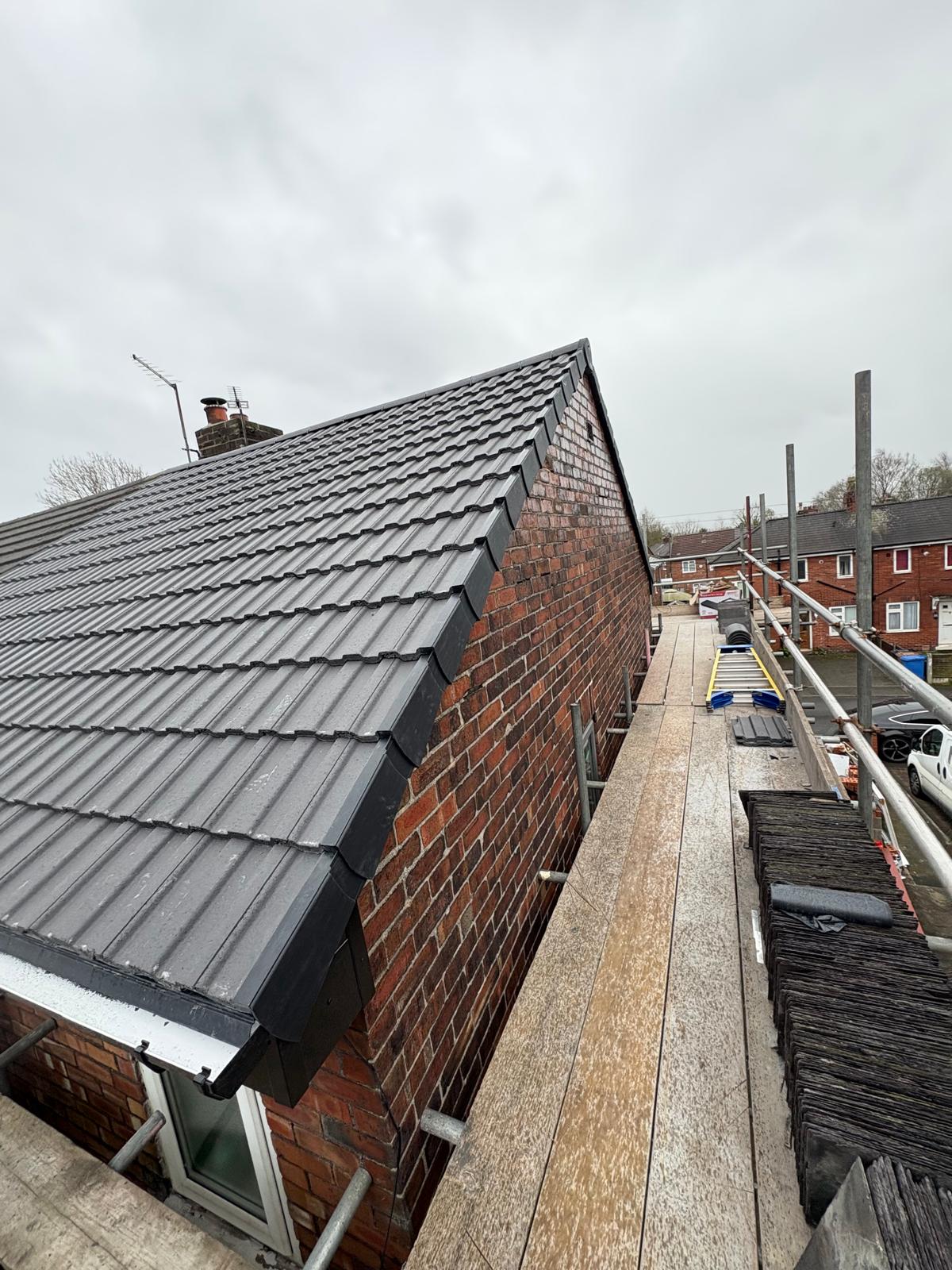
A Leak That Only Appears In Wind From One Direction
A roof that leaks only in wind from one direction has a gap that sheds falling rain perfectly well and fails when rain is driven sideways at it. That narrows the search enormously. The defect is almost always on the weather facing side, at a junction or an overlap, and it is usually small.
Key takeaways
- Rain falling straight down is easy for a roof to shed. Rain travelling horizontally at forty miles an hour is a different problem entirely.
- The leak is on the side the wind is coming from, which immediately halves the roof you need to inspect.
- Overlaps, verges, flashings and the gaps around roof windows are where driven rain gets in.
- Wind also lifts tiles slightly as it passes over a roof, opening joints that are closed in still air.
- Note the wind direction each time it happens. Two or three observations usually identify the elevation.
Why direction matters so much
A pitched roof is not sealed. It is a series of overlapping pieces arranged so that gravity carries water down the outside of each one, and it depends on water behaving predictably. Driven rain does not behave predictably. It arrives at an angle, it gets underneath the bottom edge of a tile rather than running over the top, and it can be pushed uphill by wind pressure against the slope. A roof that is entirely watertight in a downpour on a still day can let water in during a lighter but windy shower with a strong westerly behind it. This is not a sign of a badly built roof. It is the normal limitation of an overlapping system, and it becomes a fault only where a component has moved, cracked or worn.
The pressure effect people do not expect
Wind flowing over a roof does not simply push on it. As air accelerates across the ridge it creates suction on the leeward slope and lifts along the edges, which is why storm damage so often starts at the verge or the ridge rather than in the middle of a slope. That same lift opens the joints between tiles fractionally while the wind is blowing, and closes them again when it drops. It is a mechanism that leaves no trace when anyone inspects on a calm day, which is one reason wind related leaks are frustrating to diagnose. Everything looks fine, because in still air everything is fine.
The parts of a roof that give way in wind
The verge, the edge of the roof at a gable, is the most exposed line on the building and the first suspect when wind comes across that gable. Next is any junction with a vertical surface: a chimney, an abutment where a lower roof meets a wall, a dormer cheek. Then roof windows, where the flashing kit relies on being installed exactly right and where driven rain attacks the head and the sides. Then the eaves, where wind can push water back up under the bottom course. Finally the tiles themselves, where a cracked or slipped unit leaves a gap that only matters when water is arriving sideways. Ranked by how often they turn out to be the cause, verge and flashing sit well ahead of everything else.
Keeping the record that solves it
This is the one problem where a homeowner can do most of the diagnostic work without any equipment. Each time water appears, write down the date, roughly how hard it was raining, and which way the wind was blowing. Wind direction is easy to check retrospectively from any weather service, and it is named for where the wind comes from, so a westerly blows from the west onto west facing walls. After two or three events the pattern is usually unambiguous, and it tells whoever inspects exactly which elevation to concentrate on. Without that record, an inspection has to consider the whole roof, which takes longer and is more likely to miss a small defect.
Not sure what you need? Call and we'll tell you straight.
150+ Google reviews. Dave has 25 years on the tools.
Why the felt underneath matters here
Beneath the tiles there should be a secondary barrier, either bitumen felt on older roofs or a breathable membrane on newer ones, and its job is precisely this: catching the water that inevitably gets past the covering in bad weather and carrying it down to the gutter. A roof with sound underlay tolerates a surprising amount of driven rain penetration without anything reaching the ceiling. A roof where the felt has perished, torn, or was never dressed properly into the gutter has lost that second line, so every gust that pushes water past a tile puts water into the structure. This is why a leak that appears in wind is often a sign of an ageing roof overall rather than one broken component, and it is worth knowing before deciding between a patch and a larger repair.
What you can see from the ground during a storm
Wait for the weather rather than going looking in calm conditions, and stay at ground level. Stand well back on the windward side, with the building between you and the worst of it where possible, and watch the roof edge and the gable. Water sheeting off a verge rather than running down the tiles, a gutter overflowing at one end, a tile visibly lifting or chattering in gusts, spray coming through at a chimney: all of these are visible from a pavement and none of them require getting near the building. Photographs and short video taken then are far more useful than an inspection three days later in sunshine, because they capture the roof doing the thing it only does in wind.
Why waiting for dry weather is often the right call
It is urgent if a tile or a section of ridge is visibly loose and moving, because that is a falling hazard onto a path, a car or a person, and it does not care whether the inside of the house is wet. It is urgent if water is arriving fast enough to run, or is near electrics. Otherwise this is a problem that can wait for settled weather, and there is a good argument for waiting deliberately. Work at height in wind is dangerous and often prohibited, a repair made in driving rain rarely bonds or beds properly, and a leak that appears three or four times a winter has usually been doing so for several winters already. Waiting a fortnight for a dry spell generally buys a better repair.
What a proper diagnosis looks like
The elevation is identified from the wind record, then the loft is inspected to find where the water is arriving inside, then the outside of that elevation is examined at the specific junctions. A water test can confirm it, but only if done correctly: hosing the roof from below and working slowly upwards in sections, with somebody watching inside, so that when water appears you know which section produced it. Soaking the whole roof at once proves only that the roof leaks somewhere, which you already knew. Expect the fix to be specific and modest in most cases, such as repointing a verge, renewing a length of flashing or replacing a handful of tiles, and be wary of a full replacement recommended without any of that investigation.
Frequently Asked Questions
Related services
More from the blog
About the author
David Boardman founded Boardman Roofing in 2018. Dave has 25 years on the tools. Read 150+ Google reviews or call 07879 736629.
Get a free quote today
150+ Google reviews. Dave has 25 years on the tools.
Have a roof problem you want a real roofer to look at? Free written quote, no pressure.