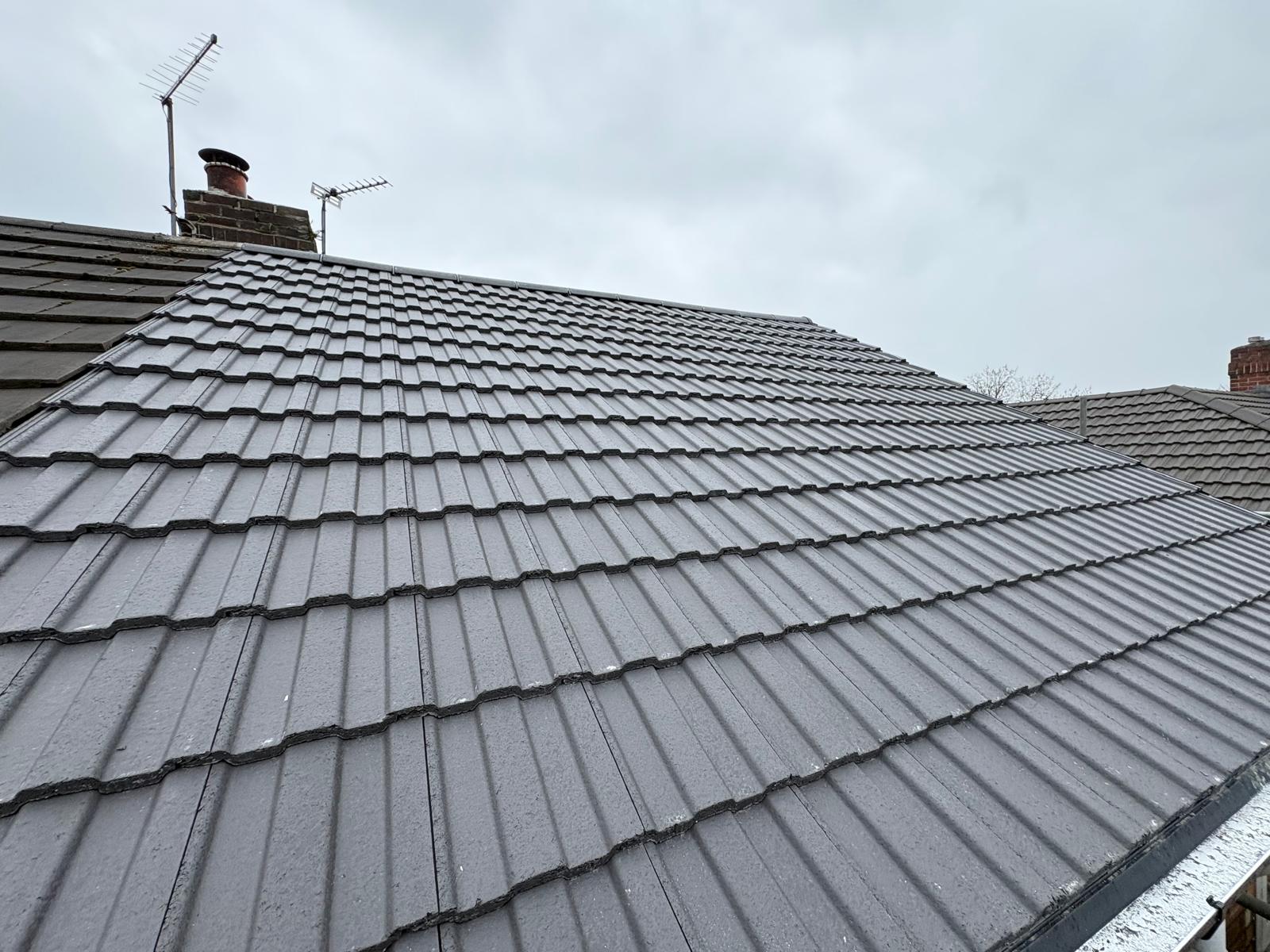
Post War Housing Roofs In Wigan And Leigh
Housing built between the late 1940s and the 1970s used concrete interlocking tile almost universally, and that material has a defined service life rather than an indefinite one. Across Wigan, Leigh and the surrounding towns, a great many of those roofs are reaching it at the same time.
Key takeaways
- Concrete tile does not fail suddenly. It becomes porous, loses its surface and gets heavier, over decades.
- A whole street built in one programme reaches the same condition in the same years.
- Early concrete tiles hold moss readily once the surface finish has weathered off.
- Nail and clip specification on these roofs was often minimal, which matters on exposed sites.
- The felt beneath is usually original bitumen and is frequently the thing that has actually failed.
What was built and why it looks the same everywhere
Post war housing was built in programmes rather than one house at a time, which is why estates from this period are so consistent. Roofs were pitched, simple in shape, covered in concrete interlocking tiles laid over battens with a bitumen felt underlay, with mortar bedded ridges and often mortar verges. The design was economical and effective: interlocking tiles cover more area per unit than plain tiles or slate, so they are quicker and cheaper to lay. That consistency is useful now, because the condition of one roof on an estate tells you a great deal about the others.
How concrete tile ages
A concrete tile leaves the factory with a surface layer that seals it and gives it its colour. Over decades that layer weathers away, exposing the coarser material beneath. The tile becomes rougher, more porous, and duller, losing the uniform colour it started with. Increased porosity means it absorbs more water, which makes it heavier and more vulnerable to frost damage, and the rough surface gives moss somewhere to establish. None of this happens quickly and none of it produces a leak on its own, which is exactly why it goes unnoticed until the roof is well into its later life.
The felt is usually the real problem
Beneath the tiles on a roof of this age is bitumen felt, and bitumen felt has a considerably shorter life than the tiles above it. It becomes brittle, cracks, tears at the fixing points and sags between rafters, and where it has sagged it holds water rather than shedding it to the gutter. Because it is hidden, its condition is invisible unless somebody looks in the loft. This matters enormously for deciding what to do: a roof with sound tiles and perished felt is a different proposition from one with both intact, because the secondary barrier that copes with driven rain is no longer there.
Fixings, and the exposure question
Interlocking tiles rely partly on their interlock and their weight to stay put, and practice on how many to nail or clip has changed considerably over the decades. On older estate roofs, fixing can be sparse by modern standards, which is generally fine on a sheltered site and less so on an exposed one. It is one reason storm damage on these roofs concentrates at the perimeter, where wind lift is strongest and the restraint is least. If a roof of this type is being recovered, the fixing specification is worth asking about directly, since current practice is more demanding than what is likely up there now.
Why the whole estate goes together
Houses built in the same programme with the same materials reach the same condition at the same time, which produces a recognisable pattern: a few years where nothing much happens, then a period where several houses on a street have work done in quick succession. If neighbours are having roofs recovered, that is meaningful information about yours rather than a coincidence. It also creates a practical opportunity, since a roofer already working on a street with scaffold in place is in a better position to price additional properties than one travelling to a single job.
Not sure what you need? Call and we'll tell you straight.
150+ Google reviews. Dave has 25 years on the tools.
Moss, and what to do about it
Weathered concrete tile holds moss readily, and on shaded or north facing slopes it can become substantial. The consequences are the ones that always follow: material breaking down and washing into valleys, gutters and downpipes where it packs at bends, water held against the covering, and added weight. Removal needs judgement, because scraping aggressively damages tiles that have already lost their surface, and pressure washing a porous tile drives water into it. The coatings and sprays marketed as a permanent solution to moss on roofs of this type deserve particular scepticism, and can complicate a future sale.
Recover, and what it should include
When one of these roofs is recovered, the work is generally a strip of the tiles, renewal of the battens and underlay, and either new tiles or the sound existing ones put back. The items worth confirming are the underlay specification and how ventilation will be handled, the fixing specification given the exposure of the site, whether the ridge will be mortar bedded or a dry system, and what happens at the verge. Those four answers are the difference between a roof that lasts and one that repeats the problems of the original. It is also the moment to deal with any gutter and fascia work, since access is already in place.
Judging where your roof is in its life
From the ground, look at colour and texture: a tile that has lost its surface reads as dull, patchy and rough compared with a recovered roof nearby. Look for moss coverage, for tiles that have slipped or cracked, and for a ridge line with missing mortar. In the loft, look at the felt for tears, brittleness and sagging, and at the timbers for staining. Then compare with any house on the street that has been done recently, because that contrast is the clearest available measure. A roof of this age that has never been touched is not necessarily due tomorrow, but it is due an assessment.
Former council housing and the right to buy legacy
A great deal of this housing was built by local authorities and subsequently bought by its occupants, which produces a specific pattern of ownership across a single street: some properties still managed by a housing provider with a planned maintenance programme, others privately owned with maintenance done when the owner decides. Where a provider recovers roofs across an estate in a programme, privately owned houses in the middle of that programme are left out, and their owners then face the junction between a newly recovered neighbour and their own older covering. It is worth knowing whether a programme is planned in your area, since it may be possible to have private work done at the same time by the same contractor, which is usually the cheapest moment it will ever be available. Housing providers will generally say what is planned in an area even to owners who are not their tenants, so the question is worth asking directly rather than waiting to see scaffolding appear.
What to do while the scaffold is up
Access dominates the cost of roofing work, so the period when a scaffold is standing is the cheapest that any work at height will ever be on that property. It is worth thinking beyond the roof itself. Gutters, fascias and soffits, chimney pointing, rendering repairs, external painting at high level and window work on upper floors all become considerably less expensive when the access is already paid for. On estate housing where several properties may be working to the same programme, the same logic extends further still. The point is to decide before the scaffold goes up rather than while it is coming down.
Frequently Asked Questions
Related services
Areas we cover
More from the blog
About the author
David Boardman founded Boardman Roofing in 2018. Dave has 25 years on the tools. Read 150+ Google reviews or call 07879 736629.
Get a free quote today
150+ Google reviews. Dave has 25 years on the tools.
Have a roof problem you want a real roofer to look at? Free written quote, no pressure.